
Changing Your Relationship with Thoughts and Feelings
We can't always choose what we think or feel, but we can change how we relate to our thoughts and feelings.
You may have tried to push an uncomfortable thought or feeling away, ignore it, or distract yourself from it, only to find it keeps coming back? It may have disappeared for some time, then returns with perhaps an even greater intensity.
Many of us learnt to manage difficult experiences this way. Whether you were told to stop worrying, to stay strong, to think positively or to push through, each of these messages may have informed how you respond or react to feelings as an adult. And quite possibly nobody showed you another way to respond to your inner experience (thoughts and feelings).
So what if you now learn you didn't need to change or get rid of our thoughts and feelings? What if what is required is to change your relationship with them instead?
This is a central focus of Acceptance and Commitment Therapy (ACT). Below are three simple metaphors I often share in counselling to help make this concept more practical.
We don't choose every thought that pops into our head
Thoughts can appear seemingly out of nowhere. Some are helpful, while others are repetitive, distressing, strange or completely at odds with your values.
Having a thought doesn't make it true. It doesn't mean you agree with it or need to act on it. And you don't need to feel guilty or ashamed simply because a thought has appeared.
Feelings also arise, sometimes before we understand what's happening. Anxiety, anger, sadness or fear may show up without warning. The harder we try to push thoughts away or feelings down, the more they compete for our attention. You may end up struggling not only with the original experience, but with your efforts to make it go away.
ACT offers a different approach: notice what's happening, make room for it, and choose how you respond.
Rather than saying, “I'm not good enough,” you would say to yourself, “I'm having the thought that I'm not good enough.” That small language change helps you to see the thought as something your mind has producing, rather than a fact you must believe or feel responsible for. ACT calls this cognitive defusion: becoming less caught up in, or fused with, your thoughts.
You can also begin to recognise that you are not your thoughts or feelings; you are the one who can notice them, and discern how to respond to them. This capacity to observe your inner experience, is described in ACT as self-as-context. It helps create space for curiosity and compassion; and room for alternative ways to respond to your inner experience.
From this space, you can consider your next step. We can't guarantee we'll always feel free to choose, especially when overwhelmed, but we can practise increasing our capacity to pause and respond with intention. This echoes Viktor Frankl's writing about the freedom to choose our attitude and response, even in difficult circumstances.
Below are 3 ACT practices for working with thoughts and feelings.
1. Leaves on a Stream: Notice it, place it down, let it pass
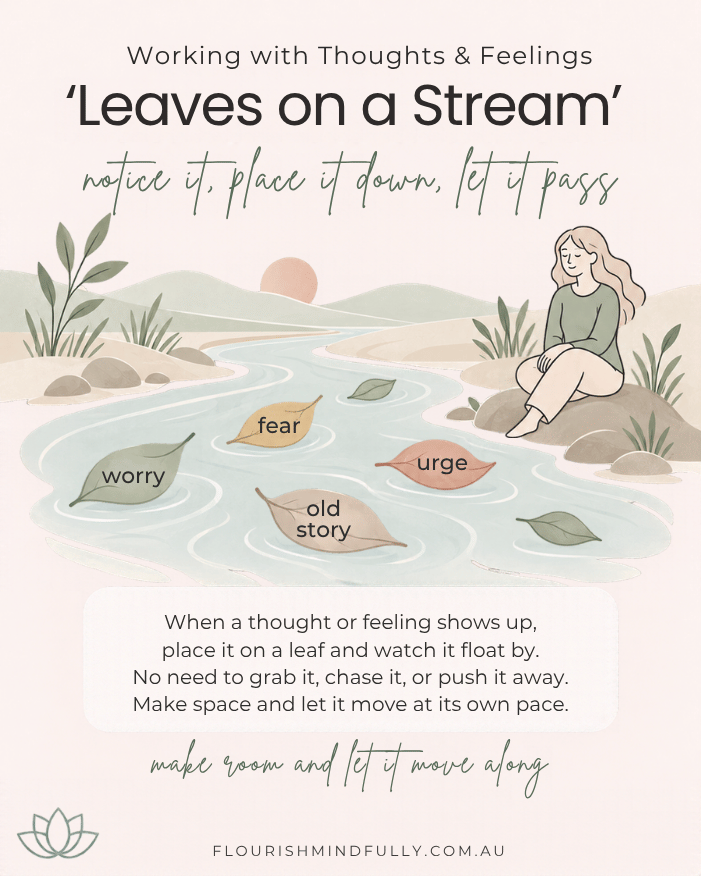
Imagine sitting beside a gently flowing stream. Leaves drift along the water, some moving quickly, others slowly.
Now imagine that whenever a thought or feeling appears, you place it gently on a leaf and watch it float downstream.
“Something might go wrong.” Place it on a leaf.
“I should have handled that better.” Another leaf.
A feeling of sadness, worry or frustration? That can be placed on a leaf too.
You don't need to follow the leaves, sweep them away, make the stream move faster or ensure they disappear. Your practice is simply to notice them, acknowledge them and allow them to enter the stream.
If you get caught up in a particular thought, that's okay. Notice that you've become caught up and gently return to your place beside the stream. Even if a leaf seems stuck, there's no need to force it along; trust it will find its way.
Try it: Take a minute to imagine the stream. As a thought arrives, quietly name it; “There's worry,” or “Here's that familiar self-critical story”. Then picture placing it on a leaf. Repeat whenever your attention is drawn back into a thought.
This is a practice of mindfulness, acceptance and defusion. You’re not trying to empty the mind. You’re learning that thoughts and feelings can be present without needing to hold your attention or direct your behaviour.
2. Passengers on the Bus: You keep driving
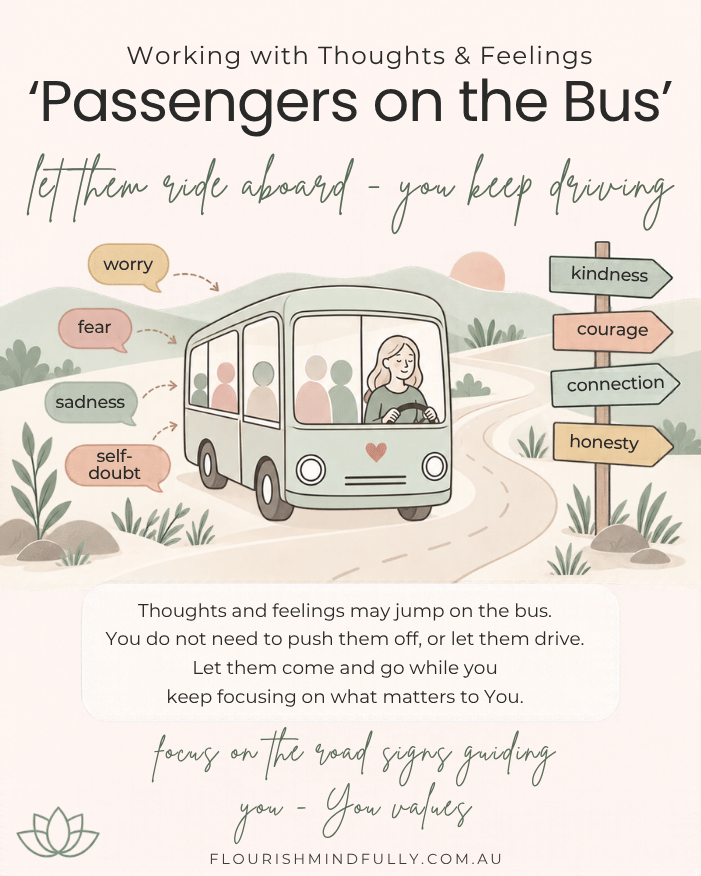
Imagine you're driving a bus along the road of your life. You have a direction you want to travel, guided by what matters to you (your Values); perhaps connection, kindness, courage, honesty or learning.
But the bus has to pick up passengers along the way. They're your thoughts, emotions, memories, experiences, fears and doubts.
Some are pleasant to have onboard. Others are loud and demanding and you’d prefer not to pick them up or offer them a ride.
Anxiety might shout, “Turn back! Something will go wrong!” Self-doubt might insist, “You can't do this.” Anger may demand that you act immediately.
The important thing is: you don't get to choose which passengers board, or exactly when they leave. But you're still the driver who decides on where to place your attention (on the road signs ahead, guiding you on your way toward what matters to you).
You can welcome them all without letting them decide where your bus goes. You may like to imagine a clear perspex screen between you, the driver, and the passengers. You can hear and acknowledge them, but they can't grab the steering wheel.
This doesn't mean ignoring genuine danger or overriding your needs. It means noticing that an uncomfortable thought or feeling doesn't always need to determine your next action, or take you off course.
Try it: When you feel pulled off course, ask yourself: “Who's speaking loudly on my bus? What are they telling me to do? What matters to me here? What's one small step I could take in that direction?”
You might say, “I hear you, anxiety. I know you're concerned. You're welcome to come along, and I'm going to keep driving.”
This metaphor brings together acceptance and values-based committed action. You don't have to wait for every passenger to become quiet before moving toward what’s meaningful for you.
3. The Dinner Party: Everyone gets to speak
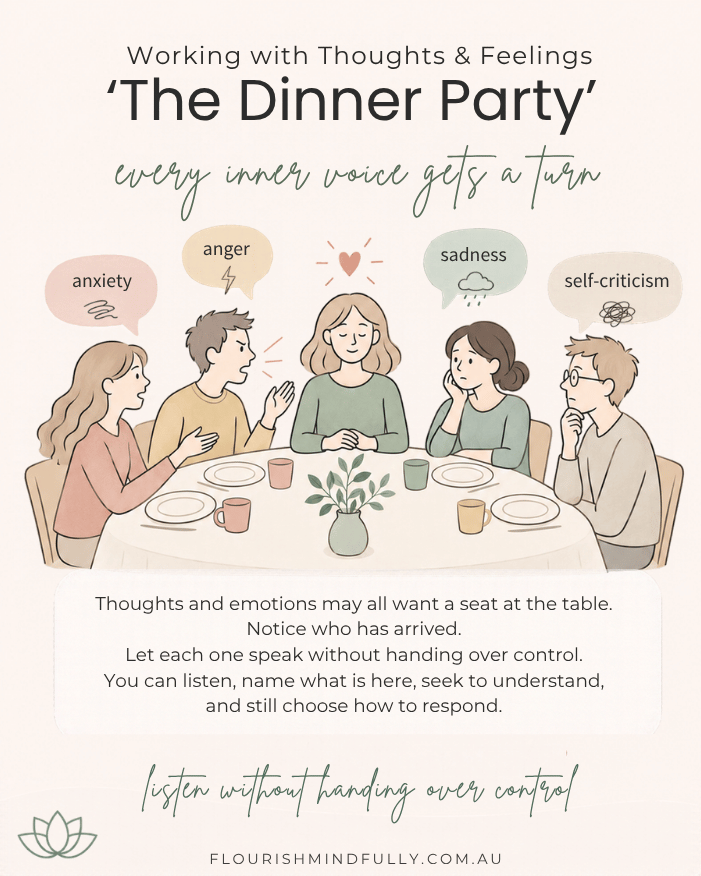
Now imagine hosting a dinner party, with your thoughts, feelings and different parts of yourself gathered around the table.
Anxiety arrives full of concerns. Anger has something urgent to say. Sadness is sitting quietly. Fear is worried about what happens next. Self-criticism keeps interrupting. Perhaps joy and hope are at the table too.
Some guests are easy to welcome. Others are the ones you’d perhaps rather turn away.
But instead, imagine yourself as a curious, compassionate host. You acknowledge each guest and let them know they'll have an opportunity to be heard, without everyone talking over one another.
“I see you, anger. I know there's something you want me to understand.” Please let me know what has got you frustrated.
“Anxiety, I can tell you're worried.” What’s been going on for you?
“Sadness, I haven't forgotten you're here.” I will tend to you shortly.
As you tend to each feeling or part of you, you may enquire about what they are responding to, what matters to them, or what they may be trying to protect you from. Anger could signal a crossed boundary; anxiety might be concerned about uncertainty or rejection. Not every emotion carries a hidden message, and you don't need to analyse them all. Sometimes acknowledgement itself is enough.
Try it: Picture you and your inner experiences seated around a table. Who's present? Can you name each guest who is present, without judging them? Is there one feeling that needs a little time and attention? What would a compassionate host say?
Noticing and naming emotions can sometimes help them feel less overwhelming. And if you can't give one your attention right now, you might say, “I see you. I'll come back and listen when I can”; then make time to return - instilling trust in your system that you will take time to listen.
Everyone is welcome at the table, and no single guest has to run the evening.
From noticing to choosing
These three metaphors offer different ways to practise the same shift: from fighting or becoming entangled in our inner experience, to relating to it with awareness, acceptance and choice.
With Leaves on a Stream, you are practising letting thoughts and feelings come and go.
With Passengers on the Bus, you are making room for them all while continuing toward what matters.
With the Dinner Party, you meet each of them with curiosity, compassion and a willingness to listen.
Acceptance doesn't mean agreeing with every thought, tolerating something harmful or doing nothing. You may recognise that anger is telling you a boundary matters, or that fear is alerting you to a genuine risk. You can take those experiences seriously without automatically acting on their first instruction.
And as you become better at recognising your own reactions, you may find it easier to stay open to other people's perspectives too. You can become curious about what their thoughts, feelings and behaviours might be communicating, while still respecting your own needs and boundaries.
Three questions to come back to
When you notice yourself becoming caught up in a thought or emotion, consider asking:
What am I noticing? Name the thought, feeling or sensation that's here.
Can I make room for this? Acknowledge it without immediately trying to push it away or change it.
How do I want to respond? Consider your needs, your values and the next helpful step.
Sometimes that step will be action. Sometimes it will be rest, support, a boundary or a little time to tend to yourself.
Like a garden, your inner world contains many different experiences. You don't need to judge yourself for everything that grows there. You can notice what's present, care for what needs tending, and choose how you want to move forward.
We can't always choose what we think or feel, but we can practise changing how we relate to our thoughts and feelings.