
When you feel stressed, anxious, overwhelmed or emotionally activated, it can be useful to have a few simple practices you know well enough to reach for when you need them.
But not every strategy suits every moment.
Sometimes you may notice yourself becoming reactive early enough to pause and create a little space. Sometimes the emotional intensity is much higher and thinking clearly is difficult; and it may be more helpful to work with the body first. And sometimes you may have enough capacity to turn towards what you are experiencing with more curiosity and care.
I think of STOP, TIPP and RAIN as useful practices for these different moments:
STOP → to create some space before reacting.
TIPP → to lower the intensity when emotion is high.
RAIN → to explore what is happening in your experience, with greater awareness and compassion.
It’s less about “Which technique should I be using?” and more:
“What would be most helpful, and accessible, for me right now?”
STOP: creating space between activation and action
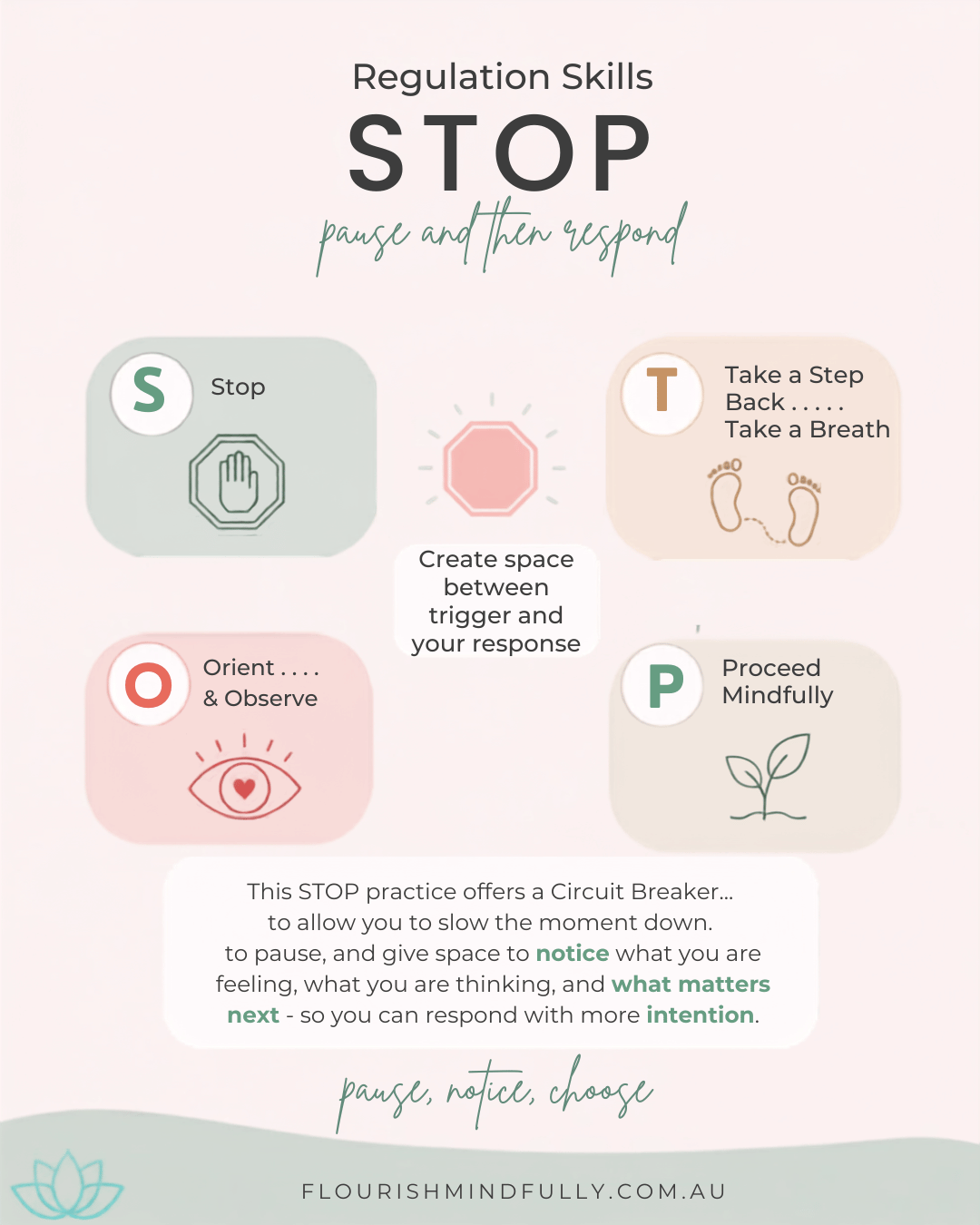
“STOP” is probably the most everyday of these three practices.
It is an informal mindfulness practice that can be used almost anywhere: before responding to a difficult email, during a challenging conversation, when thoughts begin racing, when you notice yourself becoming defensive, or simply when you realise you are operating on automatic pilot.
The commonly taught STOP practice is:
S — Stop
T — Take a breath
O — Observe
P — Proceed with more awareness
The intention is to interrupt automatic responding and create an opportunity to choose what happens next. Mindful.org offer a 4 minute recorded practice here.
The way I tend to use STOP
In my counselling work, I modify the practice slightly. I've found that when someone is already heightened or reactive, immediately turning inward and trying to work “Observe” - “What am I thinking? What am I feeling?” isn't always the most accessible first step.
Sometimes we need to create some distance, and I find when people orient themselves first, this can be enough, or a first step before beginning to Observe what is happening in their inner world.
S — Stop
Interrupt the automatic reaction. For some people using a hand gesture of a STOP sign to themselves is helpful; for others, placing a hand in this STOP symbol, on their chest works well.
You don't need to solve the situation yet. Simply notice: something is happening here; saying to yourself “STOP”, before doing the next thing - “T”.
T — Take a step back, then take a breath
This step, for me, is about creating some space.
Taking a literal, or figurative, step back can be physical interruptor for the mind - move away from the computer, put the phone down, step away from a conversation or simply shift your body backwards; a fraction, or a step or more. Or it can be figurative: a sense of mentally taking one step back from what is happening.
This acts as a small signal to yourself: I don't have to react from here.
Then you can take your conscious breath.
And there doesn't need to be one “right” breathing technique. You might use a physiological sigh, box breathing, a slightly longer exhale, gently breathe out through your mouth as though through a straw, or simply take one slow intentional breath.
The aim isn't perfect breathing. The aim is to create a little more space.
O — Orient, then observe
Traditionally, the O invites us to observe our thoughts, emotions and bodily sensations.
I often work with clients to start somewhere slightly different: to orient themselves to their environment first.
To do this - look around the space you are in and notice 3 blue things - scan until you let you gaze rest on and take in each of these objects or elements of nature.
You may then follow this with some other details of the space - the light, a window, a chair, something across the room.
And feel your feet on the floor if that is comfortable.
Orienting can help bring you back into the here and now before asking yourself to turn inward.
Then, if you have the capacity, you can take the next invitation to observe:
What am I noticing in my body? What emotion is here? What story is my mind telling me? What am I wanting to do?
This reflection can happen now, or later.
P — Prepare, then proceed
I've been increasingly drawn to adding prepare before proceed.
Instead of automatically returning to whatever you were doing, pause for one more moment:
What would help me proceed in a way that is useful to me?
Sometimes the answer has already been decided when you were calm.
Perhaps your plan is:
step away for ten minutes
use a coping statement
wait before replying
ask for some time
take another regulating breath
use a boundary you've practised
seek support.
This can be useful because you don't necessarily want to invent our best coping strategy while you’re highly activated.
Prepare > then proceed.
And sometimes proceeding mindfully may mean deciding: I'm not going to respond to this yet.
TIPP: when emotional intensity is high
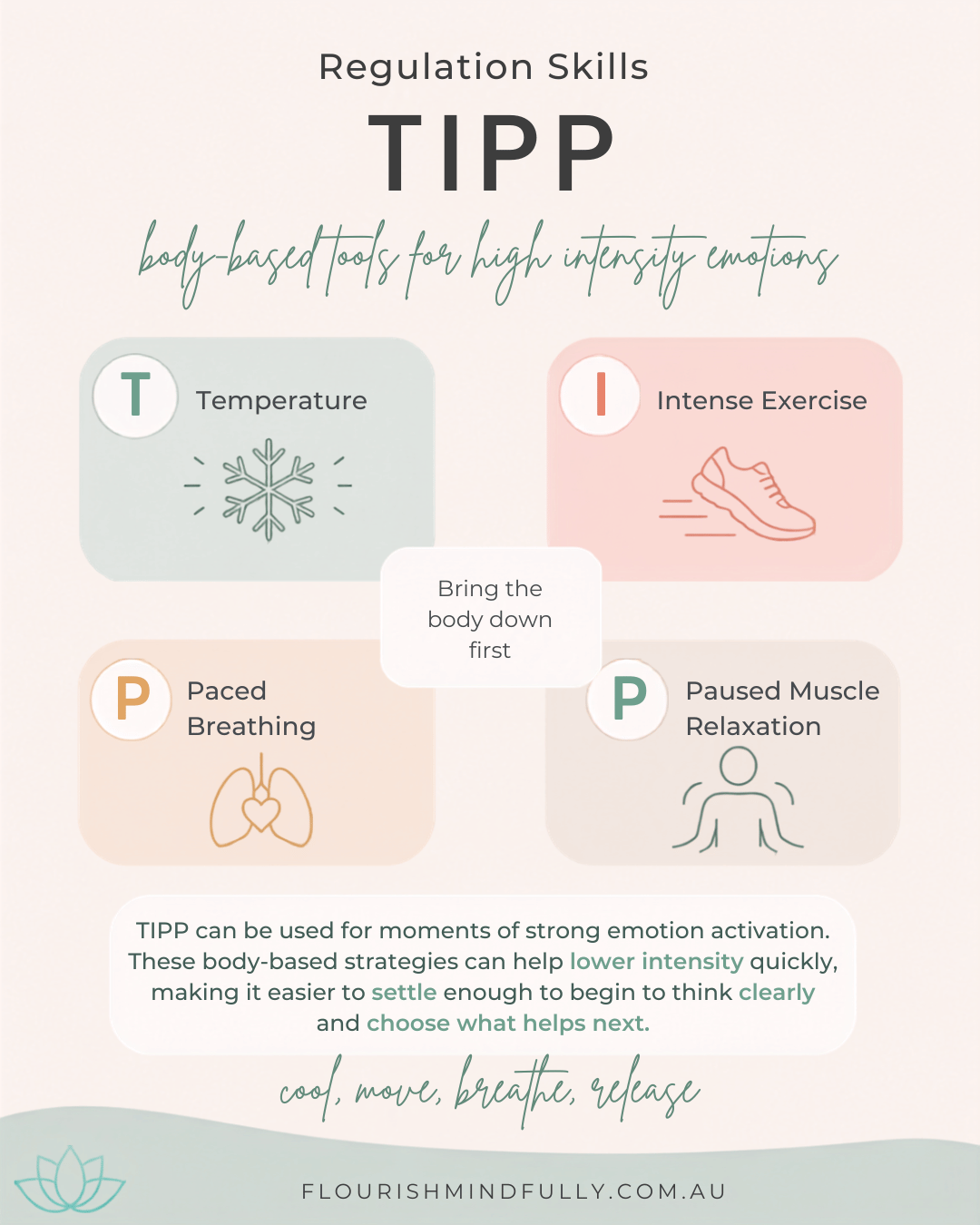
Sometimes you may immediately find yourself well beyond the point where a simple pause feels sufficient, or even available to you.
Your heart may be racing. Thoughts may be fast or repetitive. There may be anger, panic, fear, agitation or a powerful urge to do something immediately.
This is where TIPP can be a useful tool.
TIPP comes from Dialectical Behaviour Therapy (DBT) and is a distress-tolerance practice designed to influence our physiological state when emotional arousal is high. Read more here.
TIPP is a practice of working with the body first. When intensity is very high, reflective thinking may not be available to you.
T — Temperature
You could introduce a safe cooling sensation, such as cool water on the face or a wrapped cool pack. In DBT this is often extreme cold (icy cold water or using ice cubes) to dip your face in*. This isn’t for everyone.
The purpose is a short physiological shift; not to endure extreme cold or cause discomfort.
I — Intense exercise
This looks like using a brief burst of movement appropriate for your body and health.
That might be brisk walking, stairs, star jumps, running on the spot or another form of movement that safely uses some of the physical energy accompanying the emotion.
P — Paced breathing
Intentionally slowing your breathing. Allowing the exhale to become a little longer than the inhale is one option. You could experiment with the Physiological Sign, or Box Breathing, or simply extending the exhale to be a little longer than the inhale.
P — Paired muscle relaxation
To do this - gently tense a muscle group as you breathe in. Then deliberately soften and release that tension as you breathe out.
Notice the contrast between holding/tensing and releasing/softening.
The role of using TIPP is to help help lower the emotional intensity enough that you have greater access to thinking, choice and whatever skill might be useful next.
*Very cold exposure and vigorous exercise aren't appropriate for everyone, so these strategies need to be adapted to your health and physical capacity.
RAIN: when there is space to turn towards what you're experiencing
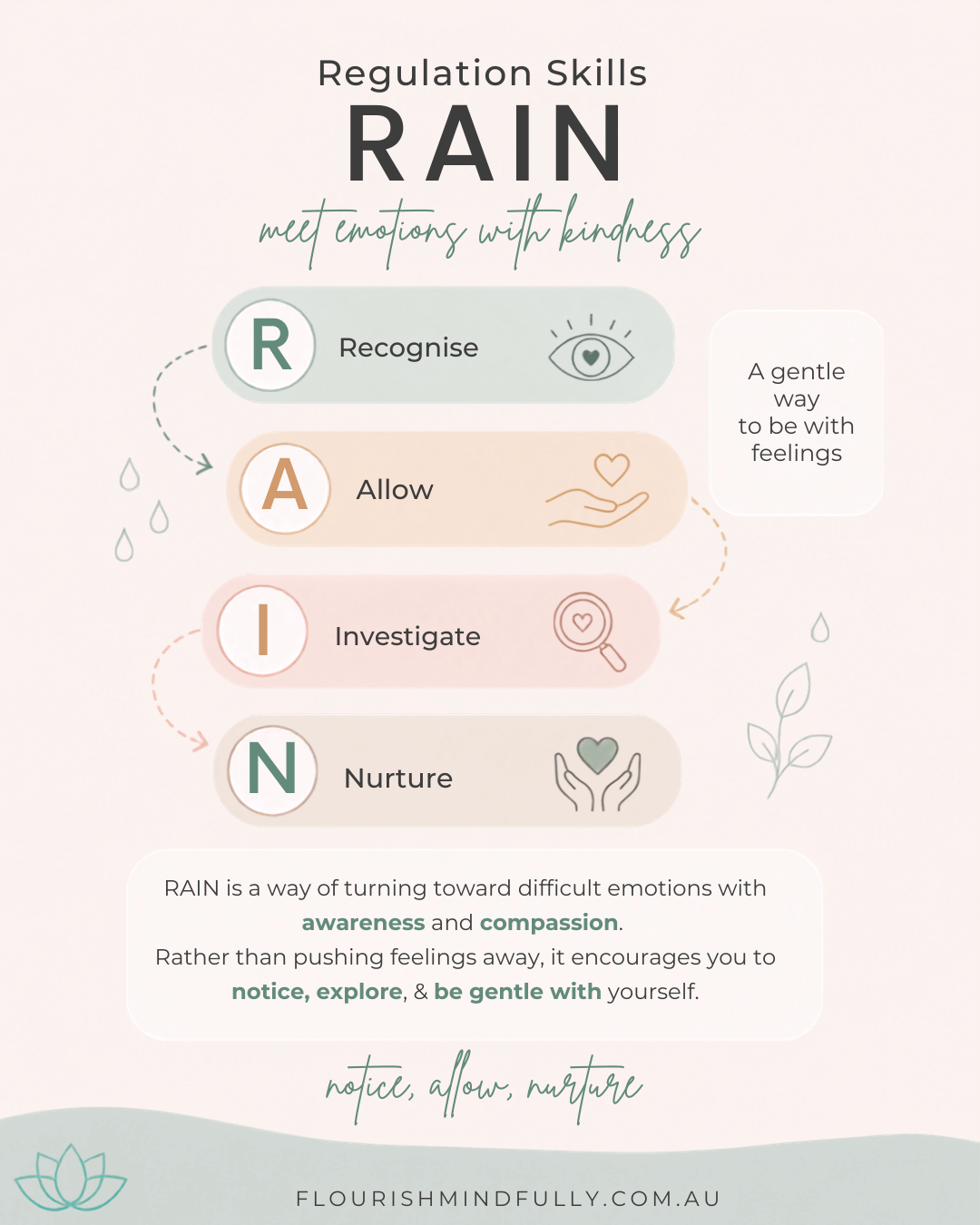
Once you have a little more capacity, this RAIN practice can be helpful in understanding yourself, and being kind and compassionate to yourself, given the context in which you find yourself.
RAIN provides a structured way to begin to turn towards your experience with more curiosity and compassion.
I use the version developed and popularised by psychologist and meditation teacher Tara Brach:
R — Recognise
A — Allow
I — Investigate
N — Nurture
R — Recognise
Notice and name what is happening.
Could look or sound like:
Anxiety is here.
I'm angry.
I am feeling hurt.
My mind is racing.
There's a tightness in my chest.
Recognising will help you to shift slightly from being completely inside the experience to also being aware that the experience is happening. This supports you to become aware that you are more than your immediate experience.
A — Allow
This step is about allowing what you have recognised to be here.
This doesn't mean you need to like it.
It doesn't mean agreeing with every, or any, thought you're having.
And it doesn't mean giving up on changing something that needs to change.
Allow is a practice to support you to not automatically feel or think you have to immediately push the experience away.
I — Investigate
Bring gentle curiosity to what you are experiencing.
You might ask:
Where do I notice this in my body?
What am I telling myself?
What feels most vulnerable here?
What am I afraid might happen?
What does this part of me need?
The emphasis of the “Investigate” step is on being curious rather than it being an interrogation.
N — Nurture
Nurturing in this practice is a way of responding to what you have discovered, with care. What might be supportive?
Perhaps it’s reassurance.
It may be a kind word or phrase to yourself.
Maybe it is a boundary that needs to be enforced.
Or it may be a hand placed gently on your body.
Or, some rest.
Talking to someone.
Taking one practical next step.
Tara Brach describes this part of RAIN as intentionally bringing self-compassion to the place, or part of you, that is struggling.
For me, RAIN is particularly useful when there is enough steadiness to recognise what's going on with some nuance.
If you're at very high intensity, investigating your inner experience may not be the best first step.
Sometimes regulation comes first.
Reflection can come later.
So which one do I use?
I find it helpful to think of these practices as sitting along a loose continuum:
Everyday reactivity → STOP to create some space.
High emotional intensity → TIPP to help the body settle first.
Capacity for reflection → RAIN to turn towards what is happening with curiosity and care.
And they can flow into one another.
You might use TIPP during a particularly intense moment, STOP when you notice there is now enough space to make a choice, and RAIN later that day, or week, when you want to understand what the experience brought up for you.
Regulation practices are tools that support you to gradually build the ability for more room between what happens and what you do next.
The goal isn’t perfect calm. Nor is it to not ever feel distressed.
It’s for cultivating more awareness, choice and agency.
Another regulation tool I'm exploring next is: PAUSE to share in an upcoming blog.
These practices are provided as general psychoeducation and aren't a substitute for individual mental health or medical care. Adapt practices to your own circumstances and physical health.