
How present-moment awareness, making choices, taking effective action and supportive rhythms can help us develop a more compassionate and trusting relationship with ourselves.
It’s easy to get caught up in the day to day demands of our time and attention. It can be so automatic, and natural. We respond to requests, manage responsibilities, navigate relationships and move from one task to the next, often without stopping to consider how we're feeling or what we might need.
Sometimes your automatic responses may be helpful. At other times, you may find yourself repeating familiar patterns that no longer serve you. This may look like agreeing with something when you’d rather say no, pushing through when you’re exhausted, withdrawing when you’re feeling overwhelmed, or finding it difficult to recognise your own needs. These patterns can be particularly significant for those of us who have experienced trauma, especially developmental or relational trauma. This is where early experiences may have involved unpredictability, fear, emotional neglect and very often there has been a lack of choice.
Recently, I completed a 50-hour professional development training in Yoga for Trauma, Anxiety, Depression and Body Image, facilitated by Sarah Ball, an experienced yoga educator, counsellor and social worker. The training was a rich exploration of trauma, mental health, body image, yoga philosophy and the wider social and relational influences on our wellbeing. It also invited us to consider how we create environments that support dignity, choice, connection and personal agency.
I want to share the supports for traumatised clients that resonated strongly with me: four principles of trauma-sensitive yoga- experiencing the present moment, making choices, taking effective action and creating rhythms. These principles are explored in the work of David Emerson and Elizabeth Hopper, at the Trauma Center Trauma-Sensitive Yoga (TCTSY).
As a registered clinical counsellor and yoga teacher, I was especially interested in how these principles connect with my therapeutic work with clients. They offer a really practical and relatable structure that aligns with and supports practices I already incorporate into counselling; supporting clients to develop awareness of their experiences, recognise their needs and preferences, make meaningful choices and develop ways of responding that feel supportive and intentional.
The psychological theories these align with include mindfulness, self-determination, self-efficacy and behavioural change. While not new therapeutic concepts, Emmerson & Hoppers work provides a useful structure and language that my clients can relate to, and support their healing and growth.
These principles are especially relevant when working with people who have experienced developmental or relational trauma, I believe they offer valuable insights for all of us. We can all benefit from practices and skills which maintain attunement to our needs, and encourage us to be responsive rather than reactive, while managing feelings of overwhelm and doing the things that matter to us.
Below I share these four principles, some of the psychology that helps explain their value, and practical ways you can apply them in your life.
1. Experiencing the Present Moment: Building Awareness and Connection
When you’re stressed or overwhelmed, your attention can become drawn into what has happened or what might happen next. You may find yourself replaying conversations, anticipating difficulties or becoming absorbed in worry and overthinking.
Present-moment awareness offers the opportunity to reconnect with what's happening here, and now. In counselling, I often refer to these practices as ‘resourcing yourself’ - meaning that you utilise can support yourself to contact the present moment, through the resource of 1. Orienting, 2. Grounding or 3. Centring). Each explained below.
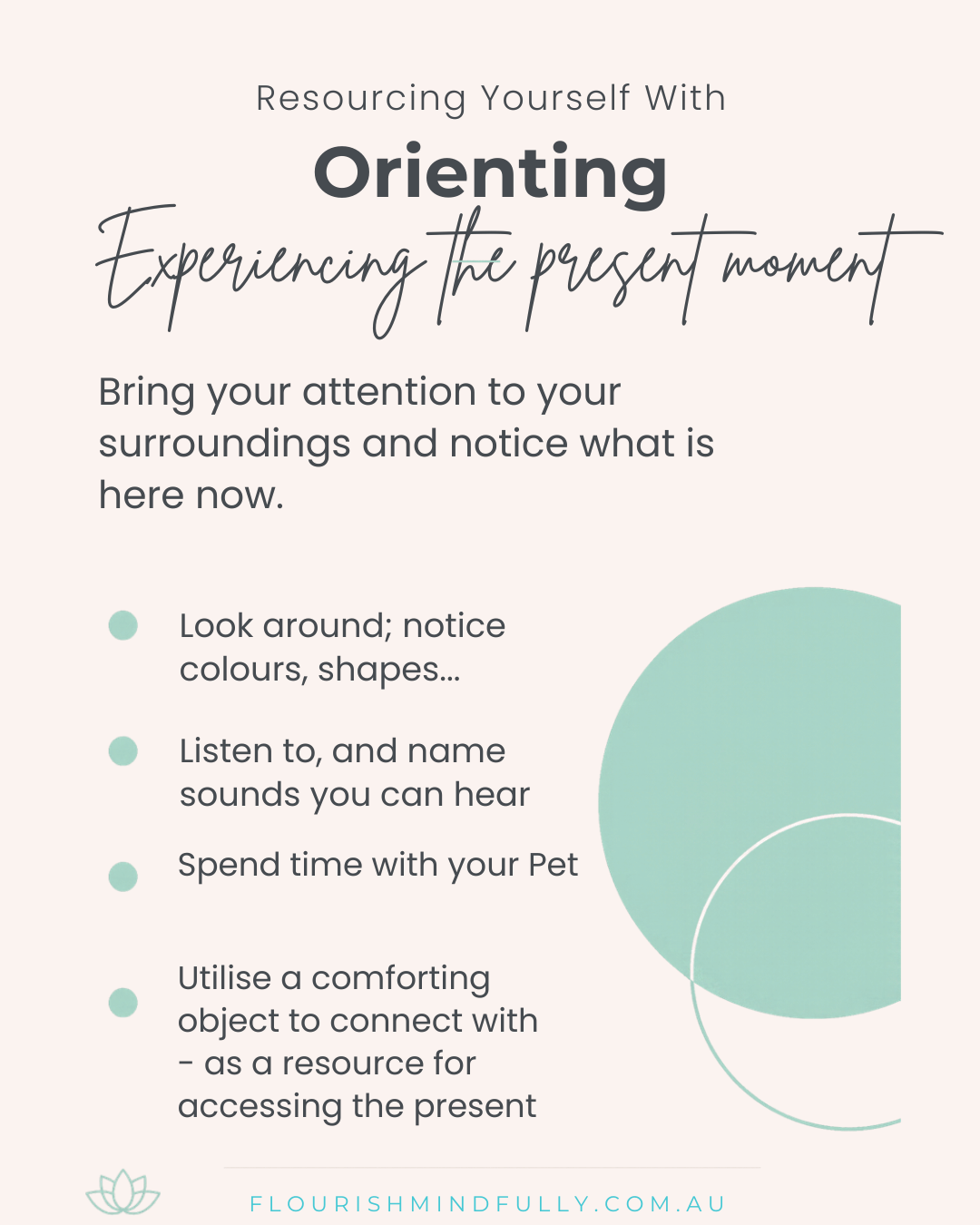
ORIENTING: Connecting with your surroundings
Orienting involves bringing your attention to the environment around you. You can do this by noticing the colours in a room (or 3 things that are blue for example), look to a window and notice it’s detail or/and what you can notice and name outside), or listen to sounds around you. Sometimes called external orienting, or external resourcing, this involves directing your attention towards information available in your physical environment, helping you reconnect with where you are in space and time.
GROUNDING: Noticing physical support
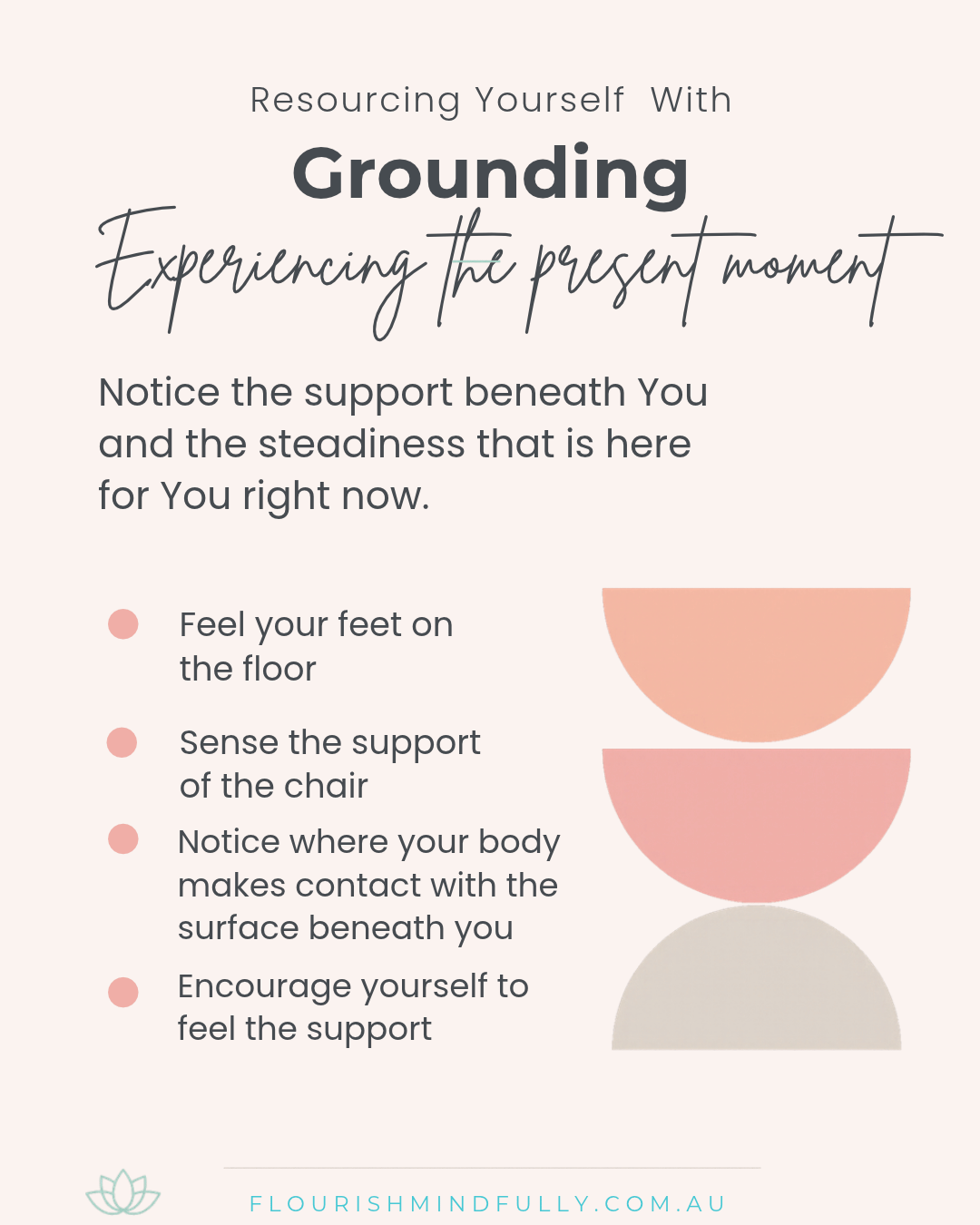
Grounding can look like you becoming aware of the contact your body is making with surface supporting you. You might notice your feet resting on the floor, the chair supporting your weight or how your hands are resting. These simple experiences can offer a familiar point of reference when we're feeling overwhelmed or disconnected; tapping in to the gentle downward force of gravity, keeping you grounded here.
CENTRING: Becoming aware of your internal experience
Centring invites you to turn your attention inward and become curious about bodily sensations. You might notice your breathing, areas of tension or ease, warmth, movement or other internal body cues.
The ability to perceive internal bodily signals is known as interoception. Interoception is increasingly recognised as relevant to emotional awareness and psychological wellbeing.
A 2024 systematic review and meta-analysis by Molteni (4) and colleagues found that mindfulness-based interventions had small-to-moderate beneficial effects on both interoceptive awareness and trauma-related symptoms. The researchers also noted that further research is needed to understand how these changes relate to one another.
Importantly, for people who have experienced trauma, bringing attention inward can sometimes feel uncomfortable or overwhelming. This is why I encourage clients to approach present-moment awareness with curiosity rather than pressure. You don't need to force yourself to feel calm, relax or connect with your body in any particular way. ‘Orienting’ is a good place to start.
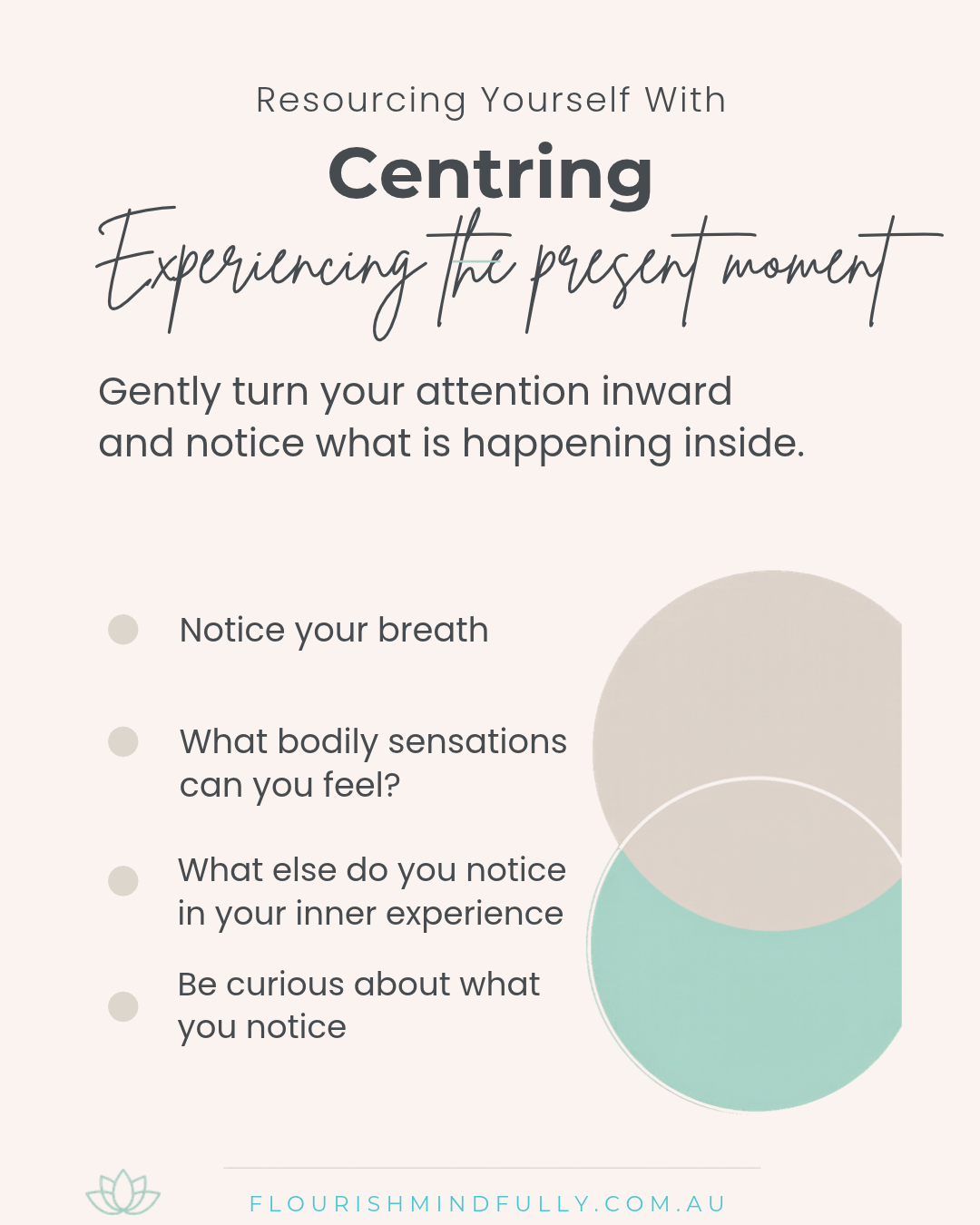
You can begin by noticing what's around you, become aware of what supports you, or gently explore what's happening inside you. And you can move between these experiences of ‘Resourcing for Present Moment Awareness’, to discover what feels most supportive for you at a particular time. The simple opportunity to choose where you place your attention begins to connect present-moment awareness with the next principle of Making Choices’.
2. Making Choices: Reconnecting with Autonomy
One of the most significant experiences associated with trauma can be the loss of choice or/and control. For those of us who have experienced developmental or relational trauma, this may have involved growing up in circumstances where expressing a preference, saying no or attending to your own needs felt unsafe or was not possible.
Over time, you may have become accustomed to accommodating others, avoiding conflict, anticipating other people's needs or responding automatically to others needs, not considering your own. Sometimes we can become so practised at attending to what others need that we lose touch with what we actually want or need ourselves. An important part of therapeutic work (eg counselling) can involve gently reconnecting with, or developing, your capacity for choice.
This aligns closely with Self-Determination Theory, developed by psychologists Edward Deci and Richard Ryan (6). Their research identifies three fundamental psychological needs: autonomy, competence and relatedness.
Autonomy involves experiencing a sense of ownership over your actions. Competence relates to feeling capable of engaging effectively with your environment, while relatedness involves feeling connected to and valued by others. Research suggests that environments supporting these psychological needs contribute to motivation and psychological wellbeing.
In counselling, some of our work is to provide clients with genuine opportunities to make choices, in the therapy session and in their daily lives. These opportunities for choices could include what we talk about, the pace of the session, whether we explore a particular experience or whether we practise an exercise in session.
Choice isn't only something we explore and you experience in therapy. If you’re not in therapy (and if you are), you can begin to practice making choices in small, everyday moments. You might pause and ask yourself:
What am I noticing?
What do I need or prefer?
What options are available to me?
What would I like to choose?
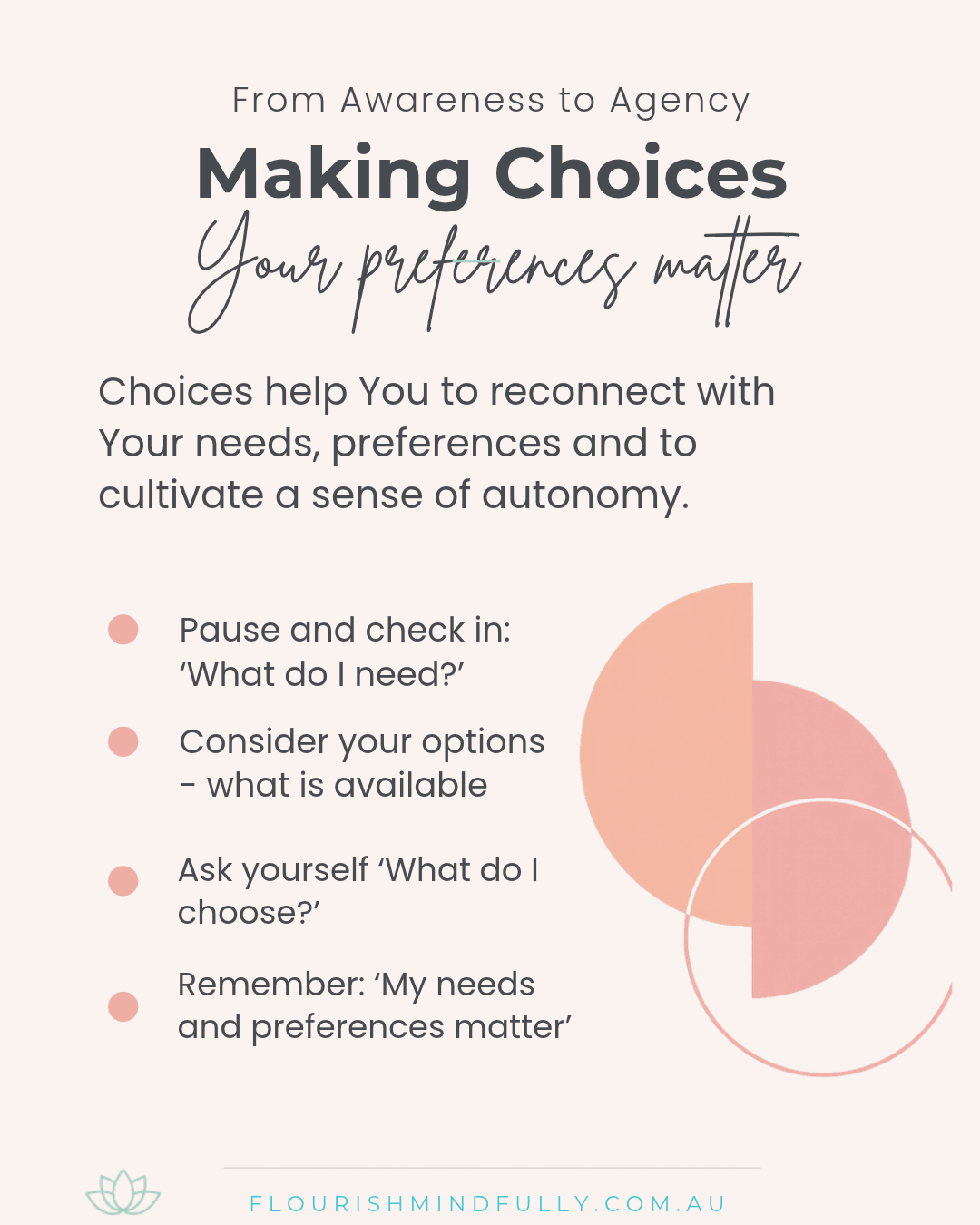
These questions can be surprisingly difficult when we've spent years prioritising other people's needs or adapting ourselves to challenging circumstances. And sometimes you may find you genuinely don't know what you want. Please know that is normal too.
The intention isn't to find the perfect answer or make the right decision. It's to begin recognising that your preferences matter, that your needs deserve consideration, and that you can begin to feel more autonomy, and agency, by practise making choices for yourself.
3. Taking Effective Action: From Choice to Agency
Recognising that we have a choice is one thing. Acting on that choice can be another. We may know intellectually that we're allowed to set boundaries, ask for help or take a break, yet still find ourselves unable to follow through. Long-established habits, fear, guilt and uncertainty can make acting differently uncomfortable. This is where the third principle becomes especially meaningful.
Taking effective action involves experimenting with small actions that reflect what we notice, need or value. For example, we might notice ourselves becoming overwhelmed during a conversation and choose to ask for a moment to think. We might recognise that we're uncomfortable and change our position, or notice that we've automatically agreed to something and decide to reconsider.
These actions may seem small, but they provide opportunities to experience something important:
I can notice what's happening. I can recognise my options. I can make a choice. I can act on that choice.
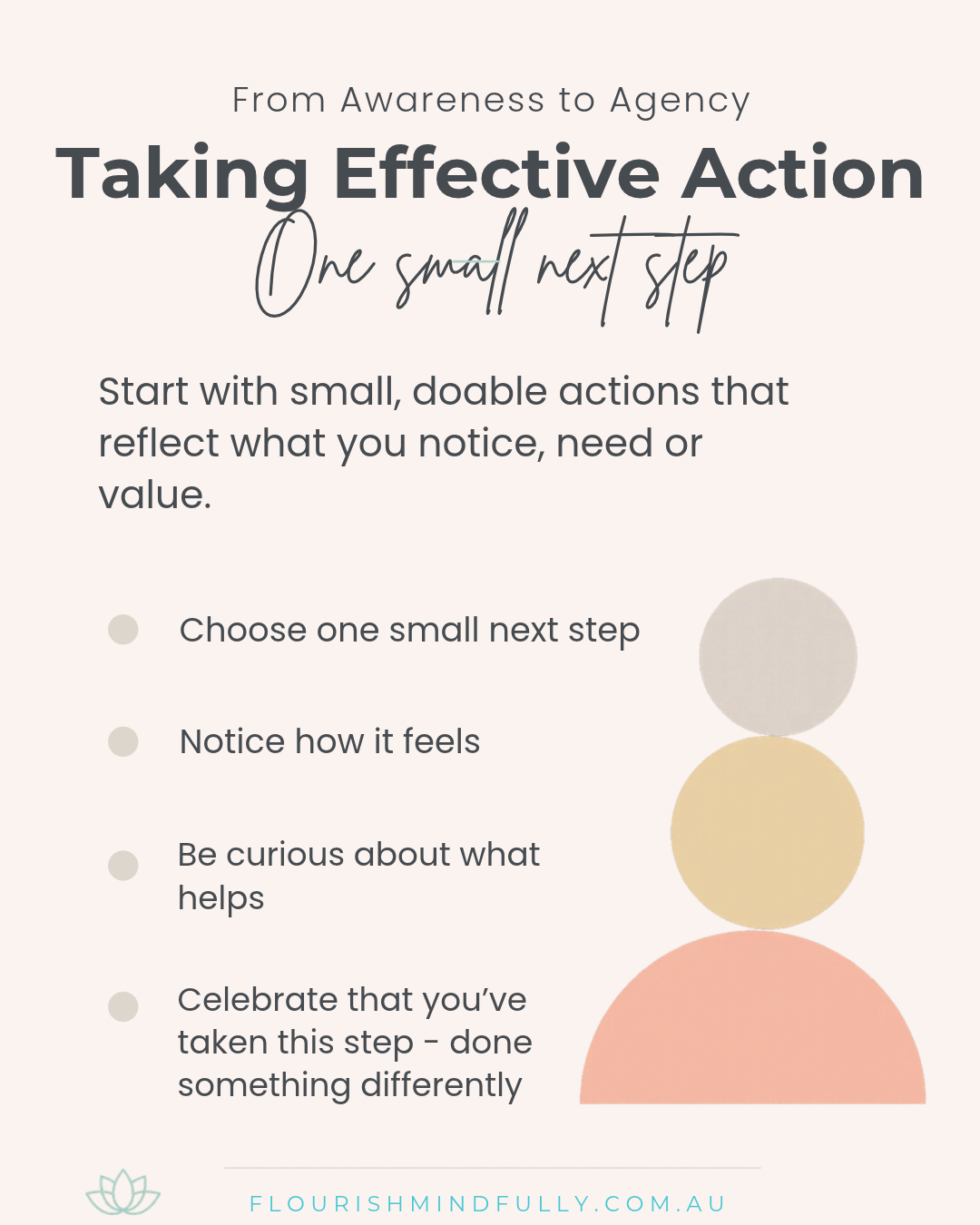
This connects with psychologist Albert Bandura's work on self-efficacy - our belief in our capacity to undertake particular actions. Bandura identified experiences of successful action as an important influence on developing self-efficacy. As we experience ourselves taking action, even in small ways, we can gradually develop greater confidence in our ability to respond to challenges and influence what happens next.
This also connects with Acceptance and Commitment Therapy (ACT), which emphasises taking meaningful, values-guided action, even when uncomfortable thoughts and feelings are present.
In counselling, I see particular value in helping clients explore the difference between recognising a choice and feeling able to act upon it. Sometimes this involves practising in very small ways, noticing what happens emotionally or physically when we consider doing something differently, and exploring what might help us take that next step.
Importantly, not every situation offers genuine freedom of choice, particularly when someone is experiencing ongoing coercion or unsafe circumstances. The aim is not to push ourselves into action before we're ready, or suggest that every difficulty can be overcome through individual effort. Instead, we can begin to explore where choice is possible and develop confidence through experiences of responding in ways that reflect our needs and values.
Meaningful change doesn't always begin with a big decision. Sometimes it begins with one small experience of doing something differently.
4. Creating Rhythms: Building Consistency and Predictability
The fourth principle is creating rhythms. I find this particularly valuable because it connects the natural rhythms of the body with the supportive rhythms we can create in everyday life. Our bodies have rhythms of breathing, movement, activity and rest. We also experience rhythms through familiar routines, relationships and predictable experiences.
For people who have lived with chronic uncertainty, instability or unpredictable relationships, consistency and predictability may be especially important. When we have some sense of what to expect, there may be fewer uncertainties to navigate. Within counselling, this can be reflected in predictable session structures, clear communication, a consistent therapeutic relationship and knowing what will happen during a particular exercise.
In everyday life, we can also create supportive rhythms that give us something familiar to return to. For example, we might develop a simple practice for transitioning from work to home, take a brief pause after a difficult conversation or create a familiar way of settling ourselves before sleep. These rhythms can become particularly helpful when linked to predictable situations.
Psychologist Peter Gollwitzer's research into implementation intentions (6) helps explain why this approach can be effective. Implementation intentions involve creating a simple plan that connects a particular situation with a chosen response; often described as an if–then plan. For example:
If I notice I'm becoming overwhelmed, then I'll pause and consider what might support me.
If I finish a difficult conversation, then I'll give myself a moment before moving to the next task.
If I arrive home feeling unsettled, then I'll take a few minutes to transition before beginning the evening.
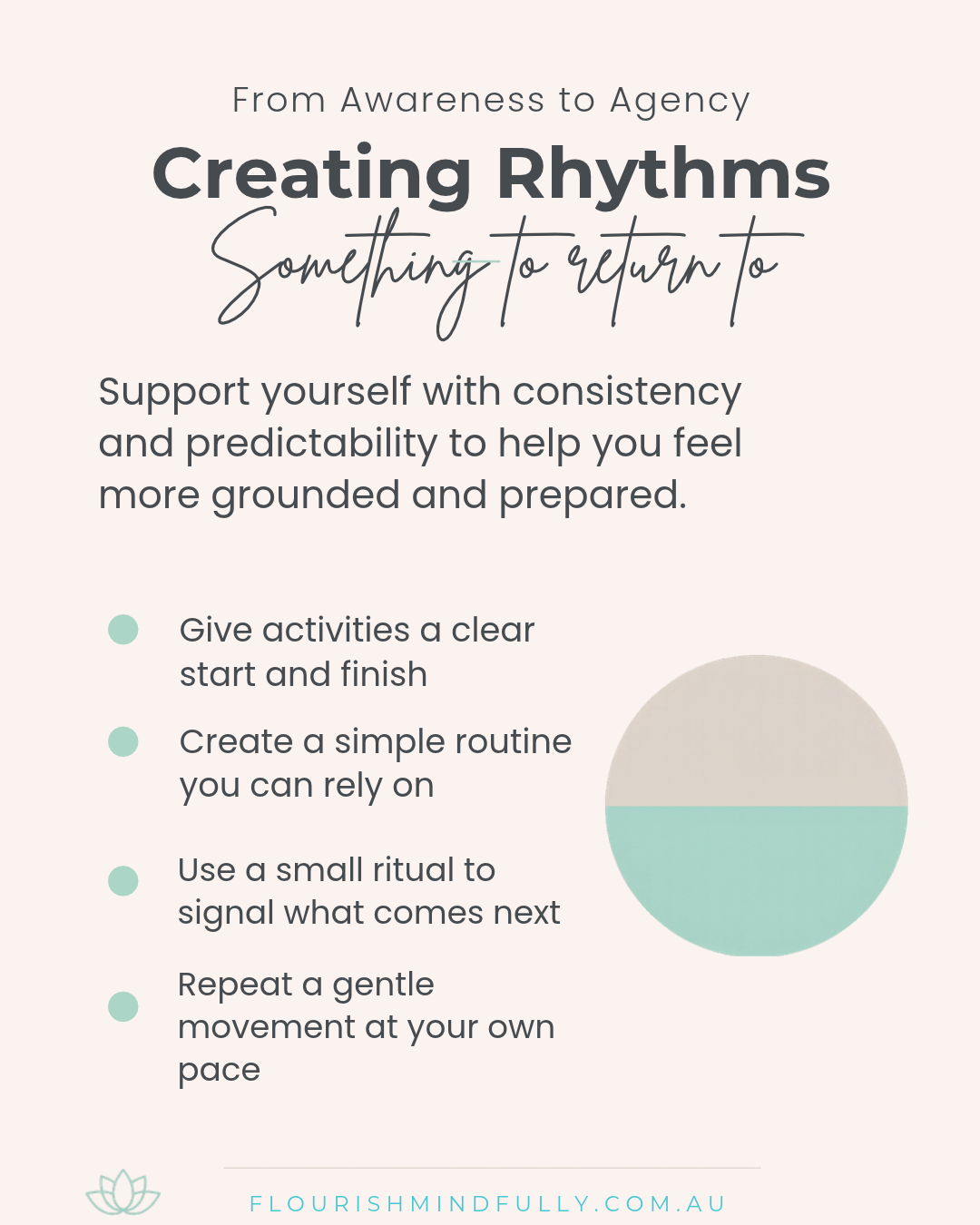
Research has found that these kinds of plans can help people translate their intentions into action. What I particularly appreciate about this approach is that it gives us something to return to when we're feeling overwhelmed or uncertain. Rather than needing to work out what to do from scratch each time, we can begin developing familiar ways of responding to ourselves.
Of course, the intention isn't to create rigid rules or add more expectations to our lives. It's about creating flexible, supportive rhythms that offer us something consistent and reliable to return to, while allowing us to respond to what we need on any given day.
Why These Principles Matter in Trauma Recovery
One of the most meaningful aspects of my recent training was the emphasis on creating environments where people can experience dignity, choice and agency.
Trauma can affect much more than our memories of what happened. Particularly when experienced during childhood or within significant relationships, it may influence how we relate to our own needs, our sense of safety, our expectations of others and our confidence in making decisions.
We may become skilled at anticipating other people's needs while finding it difficult to recognise our own. We might find ourselves responding automatically to situations that resemble earlier experiences, even when our present circumstances are different. These responses often developed for understandable reasons. They may have been ways of protecting ourselves, maintaining connection or navigating circumstances in which we had limited choices.
Therapeutic work can involve helping people understand how these patterns developed, recognising the ways they once served us, and gradually exploring what might be possible now. Trauma-sensitive yoga offers one way of approaching this through present-moment experience, choice and embodied action.
What I particularly appreciate about these principles is that they don't require us to approach the person as someone who needs to be fixed. Instead, they invite us to create opportunities for people to reconnect with their own experiences, recognise what matters to them, and begin making choices that feel meaningful and possible. The focus shifts from trying to control or eliminate every difficult response towards developing a more compassionate, flexible and responsive relationship with ourselves.
Small Practices That Can Benefit All of Us
Although these principles have particular relevance for people who have experienced trauma, I believe they offer something valuable for everyone. We all have moments when we react automatically, lose touch with our needs, struggle to make decisions or feel overwhelmed by the demands of everyday life.
Learning to notice what's happening creates an opportunity to pause. Recognising that we have options can help us reconnect with our preferences. Taking small actions allows us to experience our capacity to influence what happens next. And creating supportive rhythms gives us something familiar and reliable to return to.
These capacities don't develop through getting everything right. They develop through practice, experimentation, curiosity and compassion. We don't need to become perfectly mindful, consistently calm or always confident in our choices. There will be times when we respond in familiar ways, when we don't know what we need, or when making a different choice feels difficult. That's part of being human.
We can meet these moments with understanding rather than judgement, recognising that meaningful change rarely happens all at once. Sometimes it begins when we notice how we're feeling, recognise that another possibility exists, and give ourselves permission to respond differently. And sometimes it begins simply by acknowledging what we're experiencing, without needing to change anything at all. Over time, these small experiences can help us develop a growing sense of awareness, agency and trust in ourselves.
A Little About My Approach
At Flourish Mindfully, my counselling approach integrates person-centred therapy, mindfulness, Acceptance and Commitment Therapy (ACT), somatic awareness and other evidence-informed therapeutic practices. My recent professional development with Sarah Ball has further enriched my understanding of how trauma-aware yoga principles can inform and support the therapeutic process. I draw upon these principles thoughtfully within individual counselling, adapting them to each client's experiences, circumstances, needs and preferences.
The intention is not to prescribe yoga or suggest that these practices replace specialised trauma treatment, but to offer additional ways of developing awareness, inner resources, choice and meaningful action.
At the heart of this work, and the work I do with clients, is a belief that meaningful change can emerge through small moments of awareness, understanding and connection; when you feel heard, recognise your choices, and begin to trust your capacity to respond to yourself and your life with greater compassion toward yourself, and therefore others.
Research and Further Reading
(1) Sarah Ball — Yoga for Trauma, Anxiety, Depression and Body Image. Professional training and course information.
(2) Emerson, D. (2015). Trauma-Sensitive Yoga in Therapy: Bringing the Body Into Treatment. W. W. Norton & Company.
(3) Emerson, D., & Hopper, E. (2011). Overcoming Trauma Through Yoga: Reclaiming Your Body. North Atlantic Books.
(4) Molteni, L., et al. (2024). Effects of mindfulness-based interventions on symptoms and interoception in trauma-related disorders and exposure to traumatic events: Systematic review and meta-analysis. Psychiatry Research.
(5) Ryan, R. M., & Deci, E. L. (2000). Self-determination theory and the facilitation of intrinsic motivation, social development, and well-being. American Psychologist.
(6) Gollwitzer, P. M., & Sheeran, P. (2006). Implementation intentions and goal achievement: A meta-analysis of effects and processes. Advances in Experimental Social Psychology.