
Why do I wake at 3am? And what helps?
Why do I wake up at 3am with a racing mind?
Waking at 3am is often linked to stress, anxiety, hyperarousal, hormonal changes, or a nervous system stuck in “alert mode.” The most effective approaches focus on calming the nervous system rather than forcing sleep. Strategies such as CBT-I, slow breathing, reducing panic about being awake, and addressing daytime stress can all help improve sleep.
Keep reading to understand what your nervous system may be trying to tell you at 3am.
“Sometimes sleep is not the problem. Sometimes sleep is where the problem becomes visible.”
Why do you wake up at 3am with a racing mind - and what actually helps?
Many people think poor sleep is a simple ‘sleep hygiene’ issue; the wrong pillow, too much screen time, or caffeine late in the day. While these things can matter, chronic sleep disruption is often less about the bedroom and traditional sleep hygiene practices, and more about your nervous system, thought patterns, and the stress load you carry through the day.
In modern sleep therapy, the most effective treatments go well beyond ‘stay off your phone for an hour before bed.’ They address the psychology and physiology of sleep, particularly anxiety, hyperarousal, emotional stress, and the habits that teach the brain to stay on alert at night.
Sleep Hygiene helps, but it’s usually not the whole story
Basic sleep hygiene can support better sleep:
keeping your room dark and cool
reducing caffeine late in the day
limit alcohol
maintain regular sleep and wake times
minimise screen use / blue light, before bed
These strategies do create better sleep conditions however if your mind is racing, your body is tense, or your brain has learned that bed is a place of struggle, then sleep hygiene falls short of what you need for your sleep to improve.
What effective Sleep Therapists use
The gold standard treatment for chronic insomnia is CBT-I (Cognitive Behavioural Therapy for Insomnia). It consistently outperforms medication in the long term and focuses on retraining the brain and body for sleep.
CBT-I commonly includes consideration of:
1. Stimulus Control
The idea is to help the brain reconnect bed with sleep, not frustration or concerns of struggle, nor worry, or scrolling, or trying to fall asleep.
2. Sleep Consolidation / Sleep Restriction
Temporarily reducing time in bed to rebuild natural sleep drive, then gradually expanding sleep opportunity. This involves keeping your wake time consistent and going to bed very late, and slowly bringing this bed time gradually earlier (eg 15 minute increment over a week)
3. Cognitive Therapy - supporting you to change your thoughts about sleep
Addressing thoughts like:
‘If I don’t sleep, I won’t be able to function tomorrow’
‘Something is wrong with me’
‘I must get back to sleep; every minute awake is ruining my day’
These thoughts often increase arousal which is counter to sleep forming.
4. Consistent wake time
Getting up at a similar time daily helps regulate circadian rhythm and your sleep drive - the desire for your body to go to sleep in the evening.
5. Reducing sleep effort
Trying to force sleep can be the very thing that prevents it.
6. Reducing fear of being awake / not being asleep
Many people become worried the moment they wake in the night. Sleep therapists often work on reducing this automatic fear response.
When waking is no longer interpreted as bad, a failure, or a catastrophe, the nervous system can settle and regulate to support rest, and sleep.
Why night-time feels so hard
Many people notice their worst thinking arises at night.
This makes sense.
At night:
distractions are gone
emotions become louder
unfinished concerns surface
loneliness or vulnerability may emerge
the brain can become more threat-focused
This is why someone may cope reasonably well by day but feel overwhelmed at 2am or 3am.
For some people, old childhood patterns can quietly re-emerge at night. Fear, loneliness, vigilance, or the sense of needing to stay alert may have deep roots. This is one reason therapy can help sleep when bedtime strategies alone do not.
Brief night waking is normal
Most people wake briefly several times a night as they transition between sleep cycles. Many do not remember this because they drift back to sleep quickly.
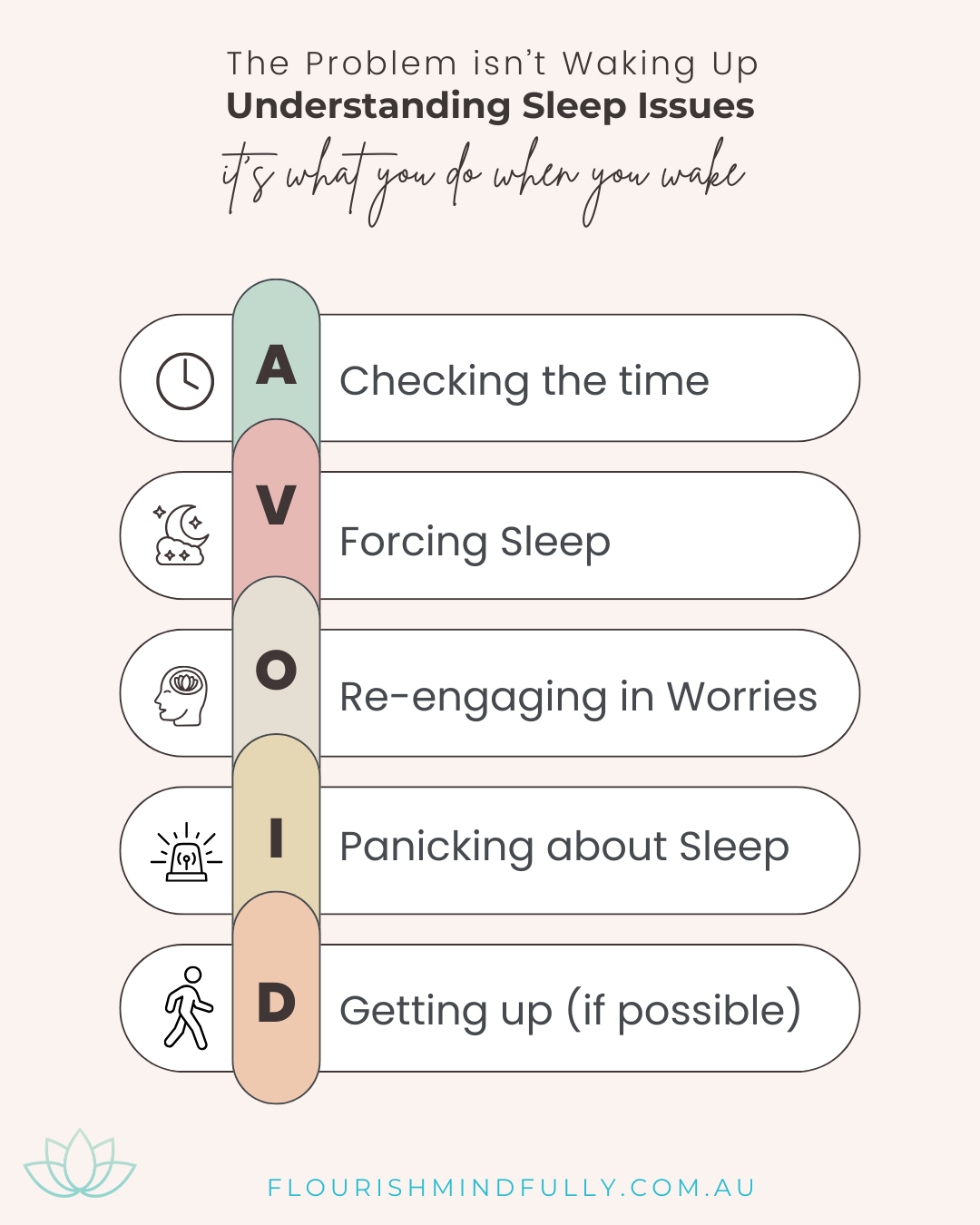
The problem is often not the waking.
The problem is what happens after waking:
you check the clock
you panic you won’t get back to sleep, or enough sleep
you try to force sleep
you rehearse the worries that emerge
you become frustrated with this situation
you get activated
A powerful reframe: awake time is an opportunity, not a threat
This can be life-changing. Instead of:
‘Oh no, I’m awake again.’
Try: ‘I’m awake... this is an opportunity to rest my body, calm my nervous system, and practice relaxation.’
You are still doing something deeply beneficial. Even if sleep doesn’t come immediately, your body and mind benefit from:
lower heart rate
muscular tension easing
stress hormones reducing
resistance not being fed
your body and mind experiencing rest
you creating the conditions where sleep often returns naturally
Sometimes the next best thing is not sleep. It is deep rest. And deep rest often becomes sleep.
Calm the body first: Your physiology matters
Sleep requires a shift into parasympathetic dominance. This is your body’s ‘rest and restore’ mode. When your heart rate is elevated, your mind is busy, your muscles are tense, and your stress chemistry high, sleep becomes harder to enter.
Rather than wrestling thoughts, start with the body.
Techniques therapists often recommend for promoting sleep
1. Slow Breathing with a Longer Exhale
Examples:
Inhale for a count of 4, hold breath for a count of 7 hold, then exhale slowly (through gently pursed lips) for a count of 8. Repeat 10 times.
Inhale for a count of 4, and exhale for a count of 6. Repeat.
When you engage in longer exhales, your parasympathetic nervous system is activated and this can help lower your heart rate and increase calm in the body.
Do 10 breath cycles; gently, and slowly.
2. Box Breathing
inhale 4
pause 4
exhale 4
pause 4
Repeat gently, for as long as is comfortable.
3. Progressive Muscle Relaxation (PMR)
Tense and release muscle groups, one section at a time, from your feet upward to your head.
This helps the body notice and let go of subtle tension you’re not aware of.
4. Body Scan
Move attention slowly through the body, noticing sensations without needing to change anything, and without judgment.
5. Gentle Counting
Count backwards by 3s from 300. This gives the mind something neutral and structured to focus on.
Give your Mind a Better Job
Anxious minds hate an empty space. If you stop worrying, you need to give the mind something else to do. If not the mind often returns to worry. Use a neutral or pleasant mental task for the mind to focus on:
replay a pleasant memory - holiday memories can be good for this
mentally walk through your childhood home
imagine cooking a recipe step by step
retell a movie scene, in as much detail as you can
mentally do your gym routine
sing lyrics silently
visualise a calming place
These mental activities occupy attention, just enough for arousal to drop, and the body’s state being more conducive to falling asleep.
The solution for improving sleep often starts during the day
Night waking frequently reflects daytime overload. This is where ‘mental hygiene’ comes in… Think of mental hygiene as like brushing your teeth, but for your mind. Night-time waking is often the visible symptom of unresolved daytime activation. This may include:
over-responsibility
perfectionism
carrying everyone else’s needs
unresolved emotional load
chronic busyness
hypervigilance
not switching off between tasks
Daily Mental Hygiene practices that support sleep
1. A Brain Dump before bed
Write down:
tasks
worries
reminders
ideas
what needs attention tomorrow
This tells the brain: It’s captured. You don’t need to keep me awake.
Follow this with a pleasant note, or thought. eg reflect on, or relive a moment you’re grateful for.
2. Schedule Worry Time earlier in the day
Set aside 10–15 minutes to think through concerns while your daytime brain is online.
3. Engage in Stress Completion rituals
Mini transitions help your nervous system complete activities, and support you to close task loops. Examples:
close laptop intentionally
short walk after work
write tomorrow’s first task
say to yourself ‘done for today’, or write this on your notebook or a post it note
4. Emotional Processing
Many people think all day, and time to feel finds its way in at night.
Helpful outlets for expressing emotional energy in the day, to discharge it from your system, or allow some of it to release:
journaling
therapy
talking to a trusted friend
prayer
tears
movement
reflection
5. Having one trusted ‘Capture’ system
Use one notebook or your notes app and capture, and contain, what needs to be remembered, or returned to. Brains often wake people when they don’t trust something has been stored safely. You could have a 🅿️ Work Parking Lot and a 🅿️ Life Admin Parking Lot in your notes app for this.
6. Evening Mental Downshift
Create a deliberate transition into night:
dim the lights
reduce any stimulation
avoid conflict where possible
perform a repetitive calming task/activity
have a warm shower
do some gentle stretching
read something supportive of nervous system staying in a regulated zone
reflect on what you are grateful for today
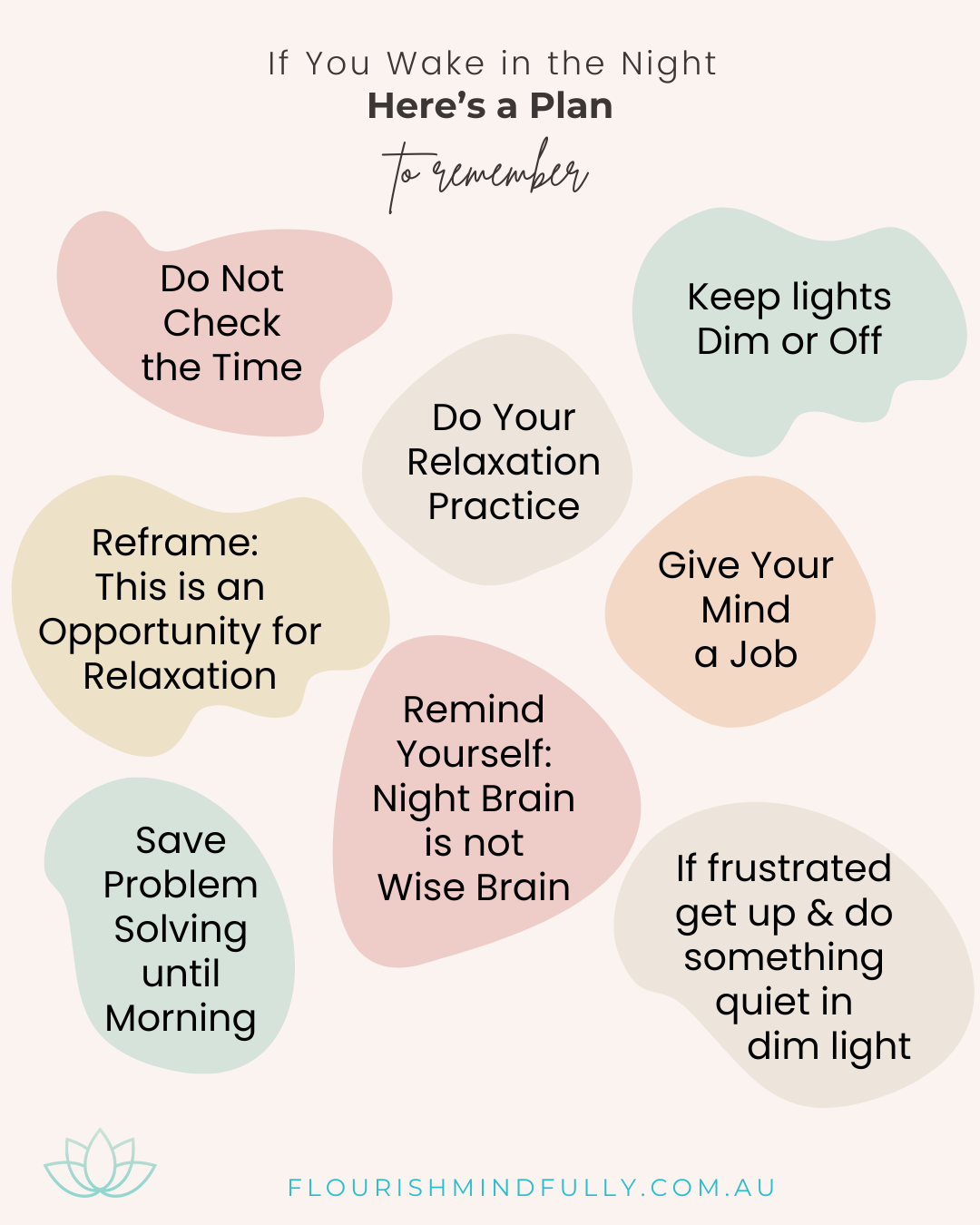
If you wake in the night: Here’s an invitational Plan
Resist checking the time.
Keep lights dim, or off.
Calm your body first - relaxation practices.
Engage in a neutral or pleasant mental task.
Repeat your reframe: This is rest time, not time to worry.
If frustrated and alert for a while, get up briefly and do something quiet in dim light until sleepy. Return to bed and engage in your relaxation practice or pleasant mental task activity
Remind yourself: Night brain is not wise brain.
Thoughts can feel more threatening and urgent in the middle of the night, than they truly are in daylight.
Save problem-solving for morning. Night is for rest, not decision-making.
Medication can be helpful, but often is not a panacea
Medication can be supportive in the short term (especially during acute stress, grief, or crisis), but the most durable change usually comes from skills, nervous system retraining, and changing your relationship with waking in the night, or sleep in general. This could look like:
retraining your nervous system
reducing your fear of wakefulness
changing your sleep habits
processing your stress
building trust in your body’s ability to sleep
It’s not about ‘fixing your sleep’, it’s often more about reducing your struggle with sleep.
When you stop treating your wakefulness as a threat (to your health and wellbeing, or your success, or some other life aspect), and as the worst thing that can happen, and reframe it as an opportunity to practice some relaxation skills or techniques (caveat - without expectations of falling to sleep), you will notice your nervous system soften; and often times sleep follows.
It’s important to remember to not be attached to the ‘sleep follows’ bit as this will trip you up. Doing a relaxation practice, without any attachment to it inducing or resulting in sleep is essential. Do the relaxation practice as a way to support your nervous system and your body’s physiology. If sleep follows, great. If it doesn’t, you’re doing the next best thing, for your body and your mind, to support your functioning the next day.
Some Self Enquiry Reflections to understand what may be impacting your sleep
What am I carrying into bed each night?
What remains unprocessed from the day?
How do I respond when I wake?
Could wake time become practice time rather than panic time?
What would support my mind to feel held before bed?
If sleep is a regular struggle
Persistent insomnia, anxiety, depression, trauma, pain, hormonal changes, sleep apnoea, restless legs, alcohol rebound, and grief can all impact sleep. If difficulties continue, seek professional support.
The problem is often not that you wake. The problem is what fear and urgency do after you wake.
If you’re wanting to work with a therapist to support your sleep please do feel free to get in touch with me and have a 10 minute chat, or book a counselling session with me.