
Do you notice there are days when you can manage a busy schedule, a difficult conversation and an unexpected change without feeling completely thrown off course.
And then, on another day, a delayed email, a change of plan or one more request may feel like too much, and send you spiralling.
The situation may not be very different; however your capacity to manage it is.
The Window of Tolerance, associated with the work of psychiatrist Dr Dan Siegel, gives us a practical way to understand what’s happening for us.
With clients, I also refer to this as their Window of Capacity or Window of Resourcing.
I prefer these terms because they move us away from the self-critical question:
Why can’t I cope with this?
and towards:
What is happening for me right now? What might my system already be carrying, and what support or resourcing would help?
This can be particularly useful if you are someone who tends to push through stress, over-function, care for everyone else, people-please, or keep going until you are anxious, overwhelmed, exhausted or shut down.
These patterns often sit underneath anxiety, overwhelm, burnout, shutdown and people-pleasing, which is why understanding nervous-system regulation can be such a useful part of learning how to respond to yourself differently.
The aim is to notice the range in which your nervous system can manage what is happening, and to recognise when your load is beginning to exceed your available resources.
What is the Window of Tolerance?
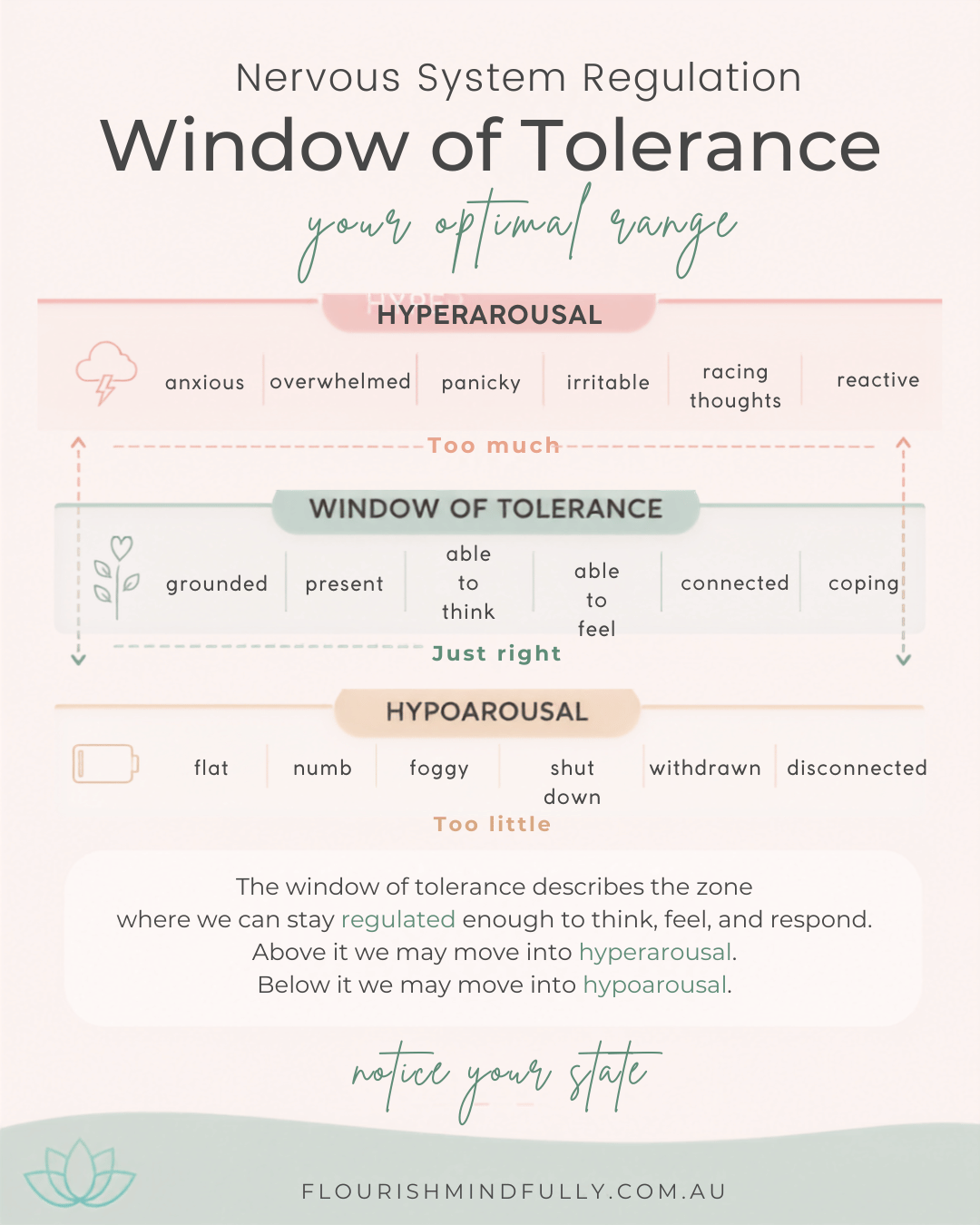
Your Window of Tolerance is the range in which you are sufficiently regulated to manage everyday life events.
Within your window, you may still experience stress, pressure, sadness, anger or anxiety. Regulation does not mean being calm all the time.
It means you have enough capacity to stay present with what you are experiencing, and make decisions from an integrated state.
Within your window, you are more likely to be able to:
think clearly
solve problems
organise your thoughts
recognise and communicate your needs
experience emotions without becoming overwhelmed by them
remain present with another person’s emotions
connect socially
respond flexibly
recover after stress
This is the zone in which you can feel and deal.
Life is still happening, but the pressure is not completely overwhelming the resources available to you. Your prefrontal cortex -the part of the brain involved in planning, perspective, impulse control and decision-making, is more available.
You can pause and consciously ask:
What is happening?
What matters here?
What do I need?
What response aligns with the person I want to be?
When stress exceeds your available resources, this flexibility becomes harder to access, and your nervous system moves into protection mode.
Above your window: Hyperarousal
When your activation rises above your window of tolerance, or capacity, you may move into hyperarousal. This is often associated with fight-or-flight energy. It may look or feel like:
anxiety
panic
irritability
racing thoughts
agitation
hypervigilance
urgency
overthinking
difficulty sleeping
anger or defensiveness
needing to fix, control or escape
feeling unable to slow down
Some people also move towards a fawn response, where you begin to appease, accommodate or manage other people in an attempt to restore a sense of safety in your system.
You might say yes automatically.
You might over-explain.
You may scan someone else’s expression or tone for signs that they are unhappy with you.
You might work harder, move faster or try to prevent every possible problem.
These responses are protective.
Your nervous system has registered a threat or an excessive demand and is mobilising energy to deal with it.
The challenge is that the body may respond to emotional, relational or anticipated threats with the same urgency it would bring to immediate, real, physical danger.
When you are highly activated, “just think rationally” isn’t a helpful prompt; your body may need support before your thinking brain can come fully online again.
Below your window: Hypoarousal
When your system has been overwhelmed, depleted or you have been unable to escape a threat, you may move below your window of tolerance into hypoarousal. This is often associated with freeze, collapse or shutdown states, in nervous system language.
This may feel like:
numbness
fogginess
flatness
fatigue
disconnection
withdrawal
low motivation
difficulty speaking
feeling unable to begin
sleeping excessively
wanting to disappear
having no access to emotion
feeling that everything is too hard
These experiences and feelings are not a result of lack of discipline, or laziness, rather, your nervous system has run out of mobilising energy and is conserving what is remaining. Your system is being adaptive.
At this point, down-regulation practices designed to make you even calmer may not be what is needed. Your system may require up-regulation, that could look like:
light
movement
rhythm
warmth
music
orientation in space and time
supportive contact with a human or animal
manageable action, that is accessible
a little momentum; eg from doing one minuscule action
This is not about dragging yourself into productivity, it is to offer your nervous system enough energy and support to begin to move again, toward your window of tolerance/capacity.
A polyvagal-informed way of understanding these states
Polyvagal theory offers one therapeutic lens for thinking about our autonomic states (the nervous system states that are happening outside of our awareness).
In the Polyvagal framework:
a state of relative safety and connection is often described as ventral vagal
mobilised fight-or-flight energy is associated with sympathetic activation
immobilised shutdown is associated with dorsal vagal protection
When we feel sufficiently safe, our social engagement system is more available. We can use facial expression, voice, eye contact and connection to communicate and co-regulate with others.
When threat rises, the nervous system may prioritise survival over social connection.
This can help explain why you may know that talking would help, yet find yourself unable to speak.
Or why you may want reassurance while simultaneously withdrawing from the person who could offer it.
Polyvagal language can be useful for recognising patterns, but it does not need to become another system for judging yourself.
The practical question to ask is:
What state am I in, and what might help my body experience enough safety, energy or support to return to be in optimal regulation (ie my Window of Tolerance/Capacity)?
Your capacity changes from day to day
Your window of tolerance is not a fixed personality trait.
It can widen and narrow across a day, a week or a stage of life.
A demanding conversation may be manageable after restorative sleep, nourishing food and time with someone you trust.
The same conversation may feel impossible when you are unwell, grieving, sleep-deprived, overloaded or already carrying several unresolved stressors.
This is why comparing today’s capacity with what you “normally manage” is not always helpful.
Capacity reflects the relationship between:
the load you are carrying and the resources available to support you at the time.
A helpful way to think about it is:
My capacity increases when the resources available to me are greater than, or proportionate to, the current stressors I am facing.
When demands repeatedly exceed recovery time and support, your window of tolerance can narrow.
What can narrow your window?
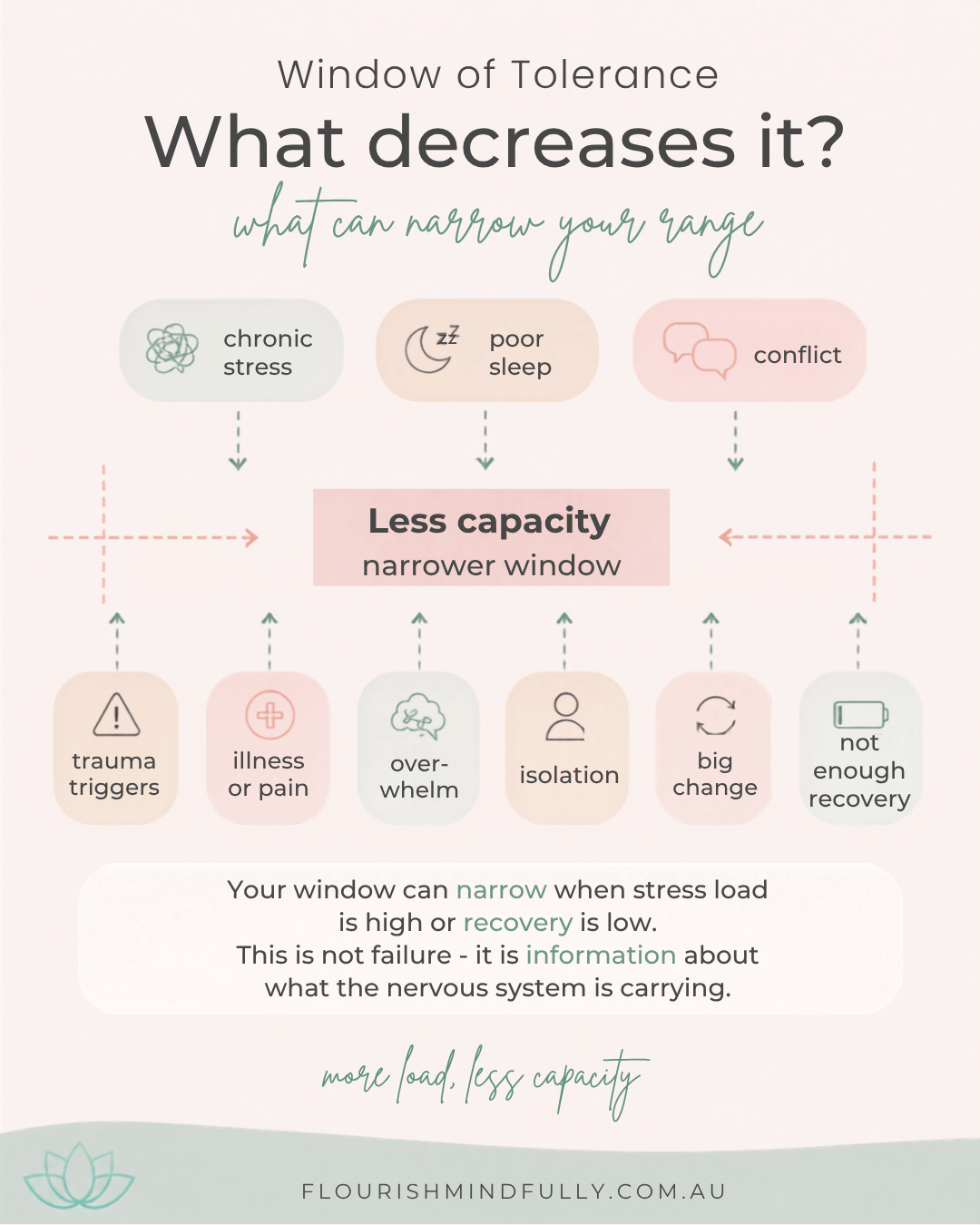
Your window of tolerance may become narrower when your stress load is high or when your time to recover is low.
Common factors include:
Biological factors
illness
pain
hormonal changes
hunger
poor sleep
physical exhaustion
sensory overload
medication changes
insufficient movement or recovery
Psychological factors
chronic worry
perfectionism
self-criticism
unresolved grief
trauma triggers
prolonged uncertainty
feeling responsible for everything
repeatedly overriding your own needs
Social factors
conflict
isolation
caregiving pressure
workplace stress
lack of practical support
relationship insecurity
feeling unseen or misunderstood
Cultural and environmental factors
discrimination
financial pressure
unsafe environments
cultural disconnection
unrealistic work expectations
living without sufficient privacy, predictability or choice
Spiritual or existential factors
loss of meaning
disconnection from values
spiritual conflict
feeling that life has become all responsibility and no nourishment
There may be several factors contributing to narrowing your window of tolerance.
You may still appear capable and productive while your internal capacity is steadily reducing.
Early signs of this include:
becoming irritated more quickly
struggling to make simple decisions
needing longer to recover after work
cancelling plans you usually enjoy
difficulty tolerating noise or interruption
feeling emotionally thin-skinned
going blank during conversations
relying on urgency to keep functioning
losing access to creativity, humour or perspective
These are not signs to push harder. They are information about your current load and your current resourcing levels, to take note of, and action from.
The Window of Tolerance as a decision-making tool
The Window of Tolerance becomes especially useful when it changes how you respond to yourself.
Before making a decision, try asking:
1. Where am I right now?
Am I:
within my window of capacity?
highly activated?
shut down or depleted?
moving between the two?
2. What is genuinely available today?
Not my usual capacity.
Not what I managed last month.
What energy, focus and emotional space do I actually have today?
3. What is adding to my load?
Is it the task itself, or the accumulation of poor sleep, uncertainty, conflict, pain, grief or too little recovery time?
4. What does this state I’m in need?
Do I need:
less stimulation?
more movement?
food or water?
sleep?
clearer information?
a boundary?
connection?
reassurance?
practical help?
time before responding?
a smaller next step?
5. What decision supports both today and tomorrow?
This may mean proceeding.
It may also mean changing the plan, asking for help, reducing the scope, delaying a decision or choosing not to add another demand.
Self-care is not always choosing what feels most comfortable. It is choosing what supports your capacity, your functioning and what matters to you over time.
The car analogy: load, fuel and the road ahead
Imagine your nervous system as a car.
When you are within your window, the engine is humming steadily.
There may be traffic, changing conditions and hills ahead, but the car has fuel and is responding well.
You can steer.
You can read the signs.
You can adjust your speed.
You can keep moving towards what matters.
When the road becomes steeper
A hill requires more energy.
You may need to slow down, change gears and focus on the next section of road.
Your values can act like road signs:
What matters here?
Where am I heading?
What pace will help me get there safely?
The hill is not necessarily a sign to stop because more fuel is required.
It is a sign that the current conditions require more energy and adjustment.
When you keep pushing without servicing the car
Perhaps warning lights appear, but you continue because stopping feels inconvenient.
You worry about falling behind, disappointing someone or losing momentum.
So you push harder.
The engine runs hotter.
More fuel is used.
Eventually, the issue is no longer the hill.
It is the accumulated cost of travelling without maintenance or recovery time.
What is needed may not be more effort.
It may be slowing down, paying attention to the warning lights and getting support before the system reaches empty.
When the car is out of fuel
Hypoarousal can feel like being stuck on the side of the road with an empty tank.
Telling yourself to “just drive” will not make the car move.
You may need a push to begin. A person beside you. A small amount of fuel.
Enough momentum to reach the next place of support; and to begin refuelling.
In this state, the goal is not a long journey. It is the next achievable movement towards replenishment.
What helps widen your window?
We do not increase our capacity simply by demanding that we tolerate more.
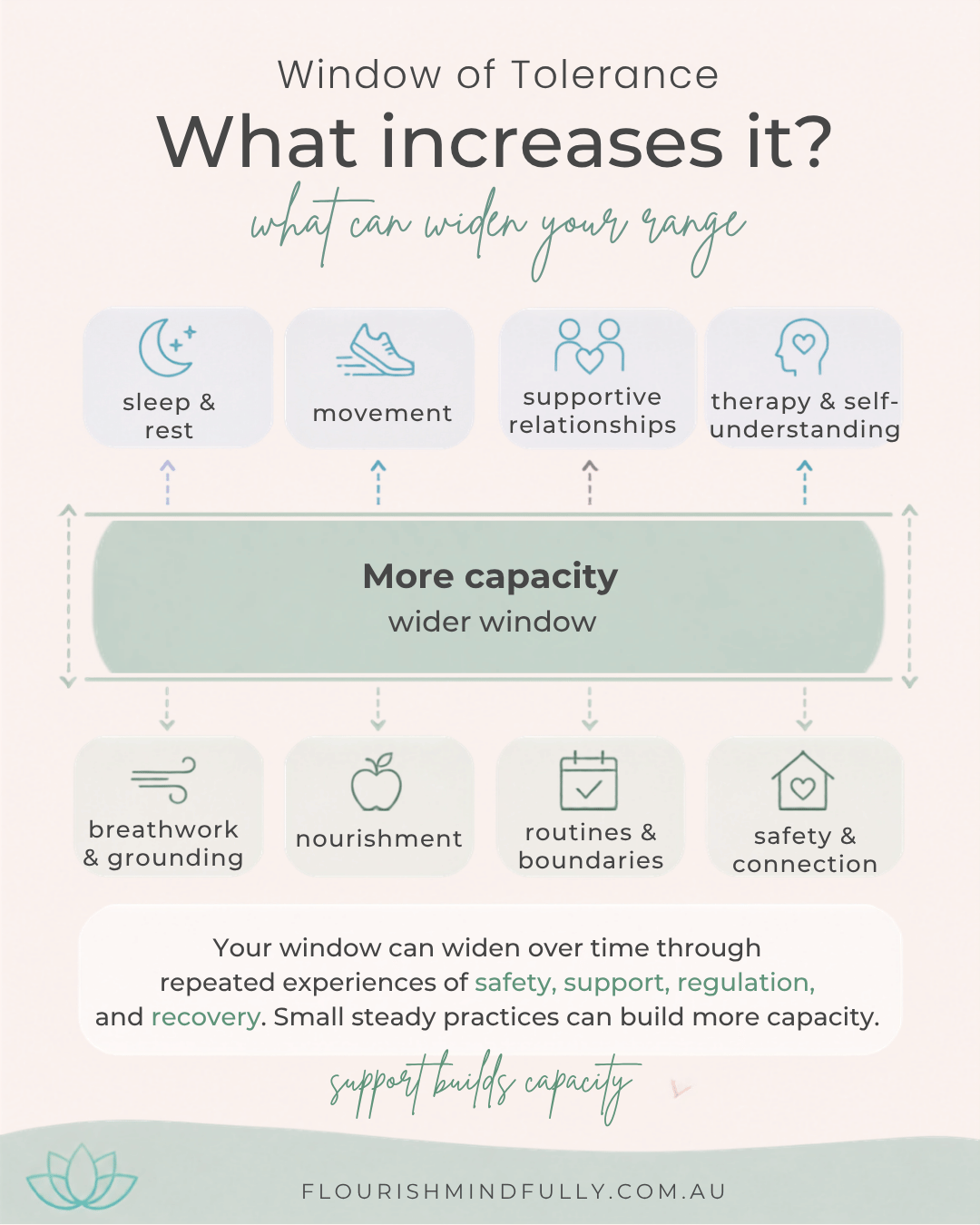
The window of capacity/tolerance can expand through repeated experiences of support, safety, regulation, recovery and manageable challenge.
The foundations: biological resourcing
The nervous system exists within your body, and basic, foundational care matters.
This includes:
sufficient sleep
nourishing and regular food
hydration
movement
daylight
physical recovery
medical care
managing pain
sensory breaks
reducing unnecessary stimulation
These foundational practices directly affect how much demand your system can carry. Self-care is often less about finding a perfect technique and more about consistently meeting these foundational needs. In our modern world, tending to these basic needs can be challenging - life is busy, commitments are real, and we can lose sight of these foundational wellbeing supports.
Psychological resources
Psychological resourcing builds awareness, choice and a more supportive relationship with your internal experience.
This may include:
counselling or coaching
self-compassion
mindfulness
journalling
learning your triggers and early warning signs
recognising automatic thoughts
developing emotion language
practising boundaries
identifying values
building confidence in your ability to cope
One practice I often use with clients is the ABC coping sentence:
Acknowledge the feeling.
Because - connect it with something that makes sense.
Choose what you can do next.
For example:
I feel anxious because there is uncertainty and I need clarity. I choose to ask one question, take one step and leave the rest until I have more information.
This does not argue with the feeling. It creates enough space for you to make a conscious choice.
Social and relational resources
Our human nervous systems are relational. Connection can communicate safety in ways that thinking alone cannot.
Resourcing in this way may look like:
time with a trusted friend
talking with a therapist
affection from a pet
shared humour
being listened to without judgment
practical support
predictable relationships
cultural or community connection
time with family members who feel safe
participating in a group where you belong
Co-regulation does not mean dependency. It means recognising that humans are built to regulate both individually and through relationship.
Cultural and spiritual resources
Capacity is also influenced by meaning, identity and belonging.
Resources that support this may include:
connection with culture
spiritual practice
prayer
ritual
time in nature
music
creativity
community
service
traditions
remembering what gives life meaning for you
These supports can reconnect you with something larger than the immediate stressor. Offering perspective, and a sense of not being alone in it.
Practices that can support regulation
Different states call for different responses.
When you are in hyperarousal: aim to support your system with down-regulation practices
In a hyperaroused state you may benefit from:
lengthening your exhale (activates PNS - rest and digest arm of your nervous system)
grounding through your feet
orienting to the room
widening your visual field - look into the distance
making slower movements with your body
restorative yoga poses
humming
singing
low vocal sounds such as “Vooooo” as you breathe out
EFT (Emotional Freedom Technique) tapping
mindfulness
warmth
supportive contact
reducing input
naming what is happening
postponing non-urgent decisions
Some people also find familiar energy-based practices, including Donna Eden–inspired routines, to be settling and containing. These can be used as personal regulation resources alongside, not instead of, appropriate medical or psychological care.
When you are in hypoarousal: aim to support your system with up-regulation practices
In this hypo-aroused state you may benefit from:
standing up
rhythmic movement
walking
dancing
stretching
brighter light
energising music
cool water on the face
looking around the room
naming colours and objects
eating something nourishing
a short practical task
contact with a safe person
voice, chanting or singing
beginning with one manageable action
The aim is not to force yourself from shutdown into high productivity. It is to add enough energy so that presence and choice become more available to you.
Perspective, attention and titration
When we are stressed, attention often narrows around the threat.
The difficult email.
The worried thought.
The person’s expression.
The thing that might go wrong.
One regulation practice is to move between narrow and wide attention.
Notice one object in detail.
Then allow your vision to widen and take in the whole room.
Notice one sensation.
Then notice the support of the chair, the floor, the sounds and the space around you.
This movement between a smaller focus and a broader perspective is sometimes described as titration - working with experience in manageable amounts rather than becoming flooded by the whole of it.
You are teaching your nervous system:
The difficult thing is here. And it is not the only thing here. This is a form of dual-awareness.
Vagal tone, HRV and nervous-system flexibility
You may hear vagal tone and heart-rate variability (HRV) discussed in relation to nervous-system regulation.
HRV describes variation in the timing between heartbeats. It is influenced by many factors and is often studied as one indicator of autonomic flexibility.
In broad terms, greater flexibility in autonomic responding is associated with a greater capacity to adjust to changing demands and recover after stress.
But HRV is not a personal grade. It varies with age, health, medication, sleep, fitness and many other factors.
It can be helpful to build the conditions that support this flexibility:
rest
movement
breathing practices
recovery
connection
emotional processing
appropriate challenge
medical care where needed
The goal is not to stay in one nervous-system state all day.
Healthy regulation includes being able to mobilise when action is required, settle when the demand has passed, and recover without remaining stuck.
Expanding your window does not mean never leaving it
Everyone moves outside their window of tolerance/capacity/resourcing.
A threat, loss, conflict, major change or period of intense pressure can push your nervous system into hyperarousal or hypoarousal.
The goal is not perfect regulation.
It is to:
recognise your state sooner
understand what contributed
respond without shame
use supports that match the state you are in
recover more effectively
build resources that work for you, over time
With practice, you may notice:
I am becoming activated.
I am beginning to shut down.
I cannot think clearly enough to make this decision yet.
I need food before I respond.
I need movement rather than more meditation.
I need support, not another strategy.
I have capacity for this, but not for three other things as well.
This is self-awareness in action.
Using my Mental Wellbeing Pulse Check
A regular wellbeing check-in can help you notice changes before your system reaches its limit.
You might rate:
stress
energy
mood
worry
sleep
physical wellbeing
emotional wellbeing
social connection
overall satisfaction
Rather than focusing on one symptom, this gives you a broader picture of current load and available resourcing.
If several areas dip at the same time, your window may be narrowing, even if you are still getting everything done.
Ask:
What is my nervous system communicating about my capacity?
What needs attention before this becomes a crisis?
What could be reduced, supported or replenished?
Which protective factor is missing right now?
The aim is not constant self-monitoring. It is earlier recognition and more informed choices.
A five-part capacity check
You can use this brief check-in during the day:
1. Notice
Where am I - within my window, activated or shut down?
2. Name
What sensations, emotions and thoughts are present?
3. Normalise
What makes sense about this response, given my current experience?
4. Need
What biological, psychological, social, cultural or spiritual need is asking for my attention?
5. Next step
What is one action that matches my current capacity?
Not the idealised version of me. Not what I think I should be able to do.
What is workable from here?
When therapy helps widen your window
Sometimes awareness is not enough on its own.
You may understand your patterns and still find that your system reacts before you can consciously choose.
This is common when stress responses have been shaped by trauma, chronic pressure, insecure relationships, repeated invalidation or long periods of carrying too much without support.
Therapy can help you:
give language to your state
recognise what state you are in
understand your protective patterns
identify your triggers
develop practices matched to your nervous system
process experiences that keep your system on alert
determine and strengthen your boundaries
build self-trust
increase your emotional capacity
experience safe connection and co-regulation
The aim is not to remove every stress response. The aim is to build enough resourcing that your system has more options available to it, to support your daily functioning.
A final reflection
The Window of Tolerance offers a way to understand why your capacity changes.
It’s a way to notice when pressure is exceeding your inner and outer resources.
It is a way to make decisions based on what your nervous system is carrying, not only on what is written in your diary.
And an invitation to ask yourself today:
Where am I in my window?
What has added to my load?
What resources are available to me?
Do I need to settle, energise, connect, recover or ask for help?
What choice would support both the demand in front of me and me, the person carrying it?
Your nervous system is not failing when it signals that capacity is low. It is communicating with you.
Learning to listen gives you the opportunity to respond before the warning light becomes a breakdown.
Support with stress, anxiety and nervous-system regulation
If you are frequently moving between anxiety, over-functioning, exhaustion and shutdown, counselling or coaching can help you understand your patterns and develop supports that fit your life.
As a counsellor, yoga and meditation teacher, I work with the mind and body together, supporting clients to build awareness, improve regulation, strengthen boundaries and create more sustainable capacity.