
Your breath is always with you.
It happens without you needing to think about it - and yet, so wonderfully, you can also gently guide it.
That is what makes the breath such a powerful bridge between body and mind.
As a counsellor, yoga teacher and meditation teacher, breath practices are some of the tools I often share with clients, as:
A small pause.
A simple anchor.
A way to support your nervous system.
A gentle return to the present moment.
When we bring awareness to the breath, we are working with something that is both involuntary and changeable. The body breathes for us, but we can also consciously shift the rhythm, shape, pace or texture of the breath.
This can be especially helpful when we feel anxious, stressed, scattered, overwhelmed, or caught in thinking loops.
And for many people, “just breathe” is not enough.
That is why adding a count, a shape, a tactile cue, or a visual pathway can be so useful. It gives the mind something extra to follow. More anchor points. More places for attention to land on.
Below are six of my favourite breathing practices - simple, accessible and easy to return to throughout daily life.
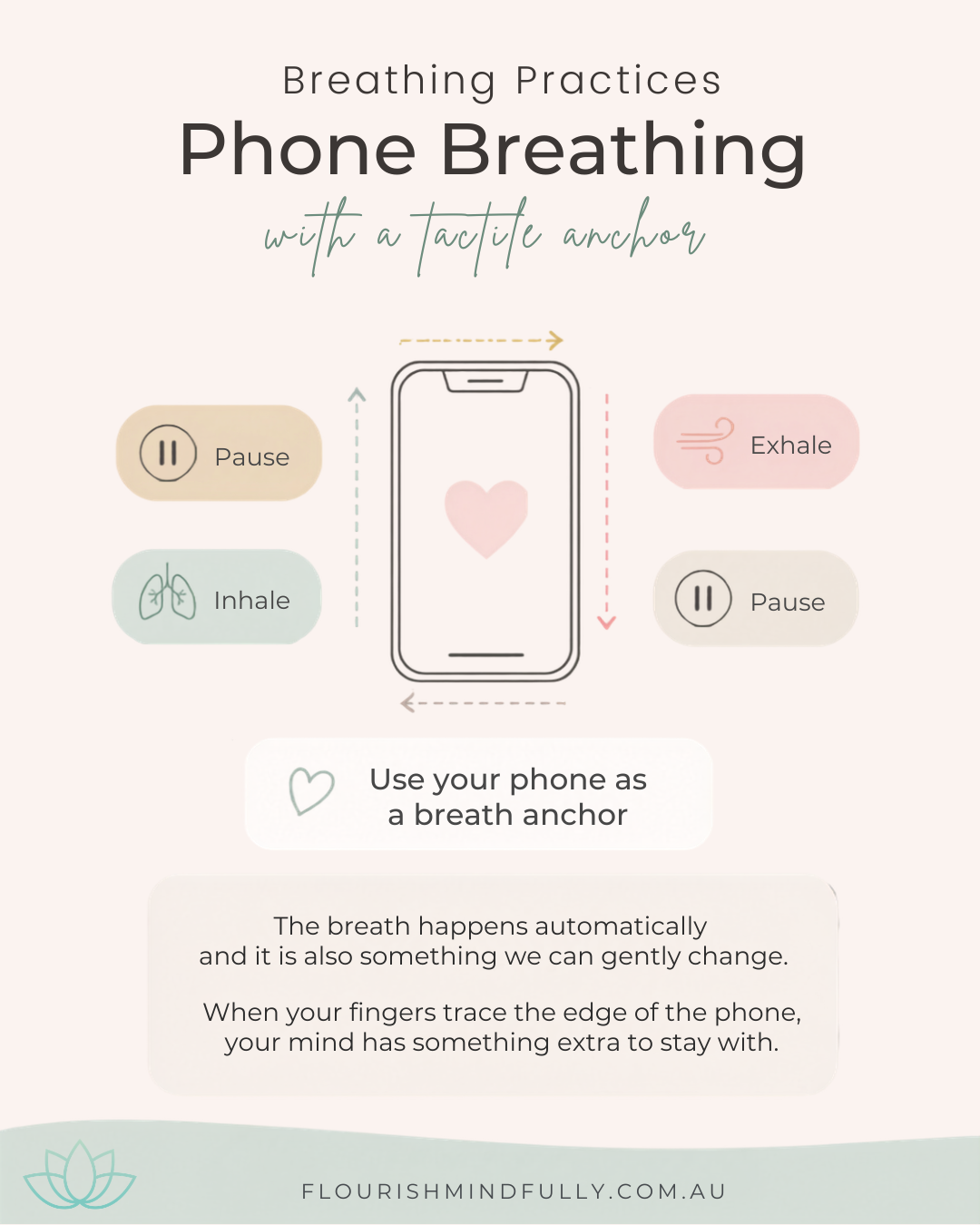
1. Phone Breathing
Phone breathing is one of my favourite simple grounding practices because most of us have our phone nearby.
And often, when we feel stressed, anxious, bored, uncertain or overstimulated, the phone becomes a portal to distraction.
This practice invites the phone to become something different.
A grounding tool.
A tactile anchor.
A doorway back to the present moment.
To practise, hold your phone gently in one hand. Trace the outside edge of your phone slowly with your finger, or let your eyes follow the rectangle.
Breathe in along one long edge.
Pause along the short edge.
Breathe out along the next long edge.
Pause along the short edge.
Continue, breathing in along the next long edge.
The shape, the touch and the breath all give your busy mind somewhere to land.
This can be especially supportive when you are waiting, overthinking, between clients, before a meeting, or sitting in the car before walking inside.
Try this: next time you reach for your phone to scroll, pause for one round of phone breathing first.
2. Box Breathing
The breath is always happening in the background; involuntary, reliable, and quietly keeping us alive.
And yet, when we bring gentle awareness to the breath, we can begin to influence how we feel, through changing the rhythm, the cycle, the length, and our attention.
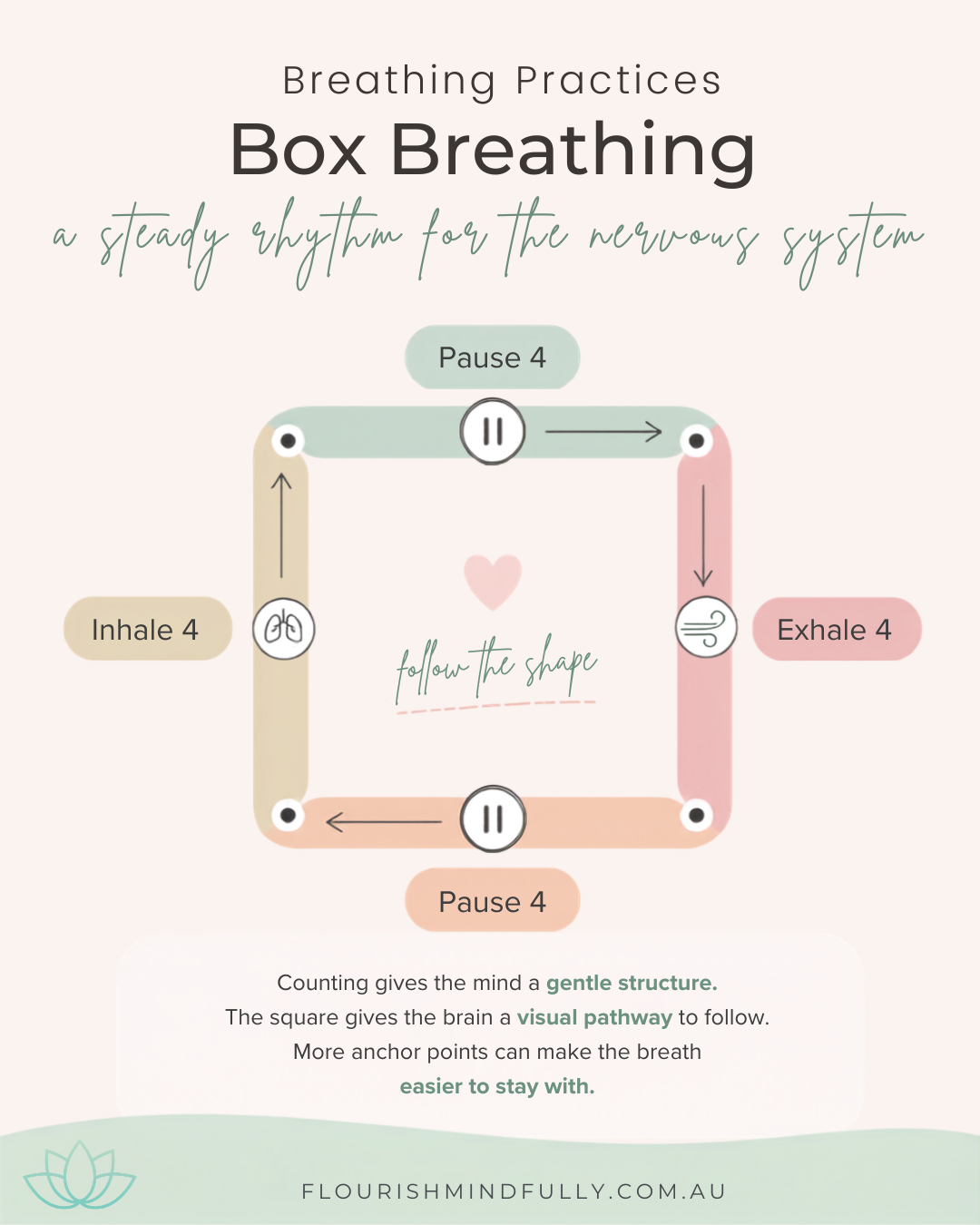
Box breathing gives the breath a shape:
Inhale.
Pause.
Exhale.
Pause.
A simple pattern with a steady rhythm, providing structure when the nervous system feels scattered.
You might inhale for 4, pause for 4, exhale for 4, and pause again for 4. Or you might choose a softer count, such as 3-3-3-3, or 2-2-2-2, building up to the 4-4-4-4 version.
You can also trace a square on your palm, follow the outline of your computer screen with your gaze, or draw an invisible square with your fingertip. Box breathing is commonly described as a structured breathing practice that can support calming, stress relief and focus.
This is especially helpful for people whose minds need more than “just breathe.”
The count gives the mind something to follow.
The shape gives the body a sense of containment.
Try this: before a difficult conversation, after a stressful email, or when your day feels like it is running ahead of you.
Give your mind a shape to follow, and your body a rhythm to settle into.
3. 4-7-8 Breathing
The breath is always available - even at 2am, when the mind is busy and the body won’t quite let go.
4-7-8 breathing is one of my favourite practices for bedtime, or for those moments you wake in the night and need some support to get back to rest.
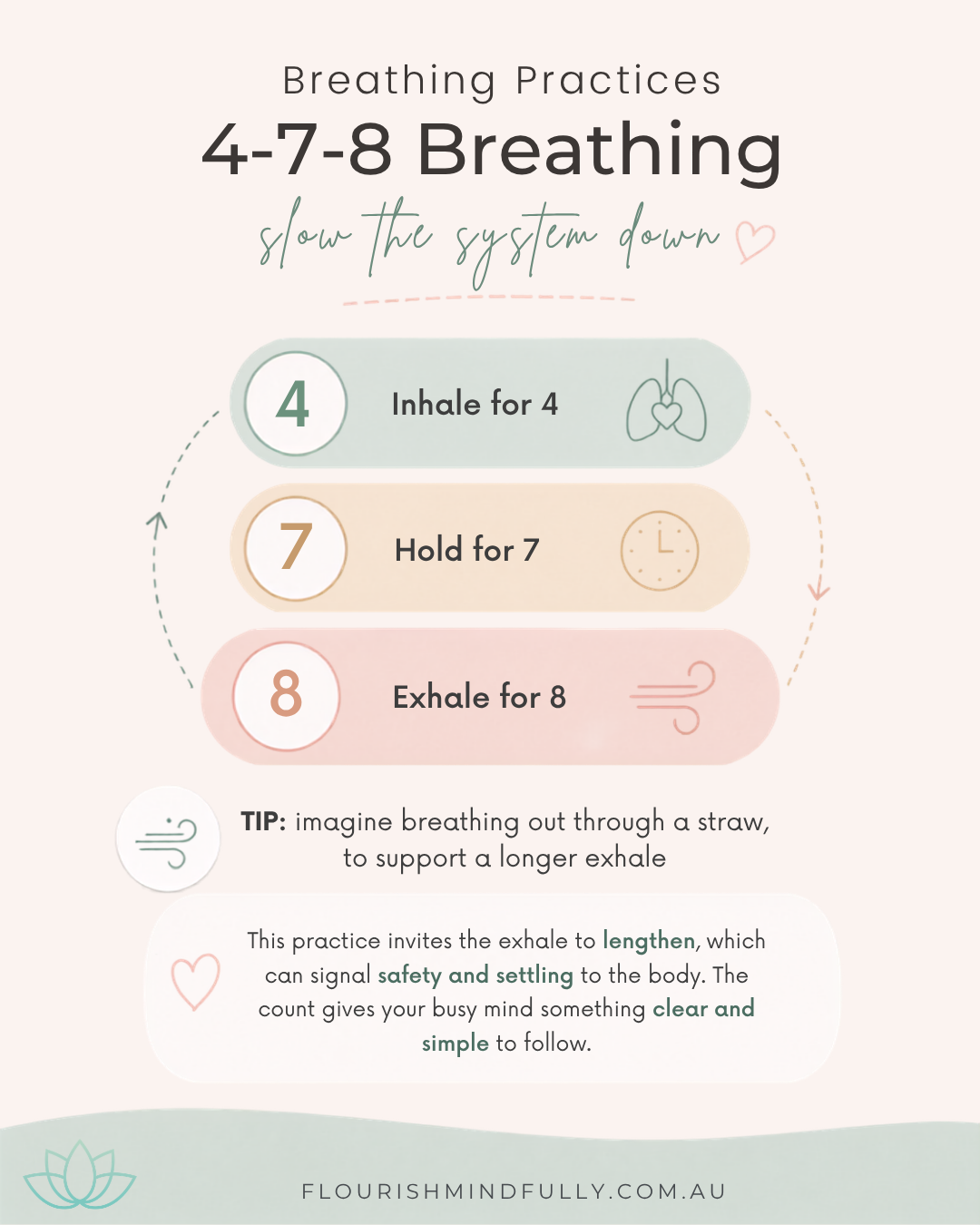
Inhale for 4.
Hold for 7.
Exhale slowly for 8.
The longer exhale is the key. It gently invites the body toward slowing, softening and settling.
For anxious, high-functioning, over-responsible humans, bedtime can be the moment everything finally catches up.
The emails.
The conversations.
The decisions.
The things not done.
The things still needing attention.
This practice gives the mind a count to follow and the nervous system a rhythm that says, you can relax. The long exhale activates the Parasympathetic Nervous System - the rest and digest arm of the nervous system, supporting the body and mind to settle.
Try this: lying in bed, with one hand on your belly and one hand on your heart.
If the 7-count hold feels too much, try inhale for 4, pause gently, and exhale for 6 or 8. Do not strain.
4. Physiological Sigh
Sometimes the body needs a quick signal to relax, and the physiological sigh breath is helpful for this.
To practise:
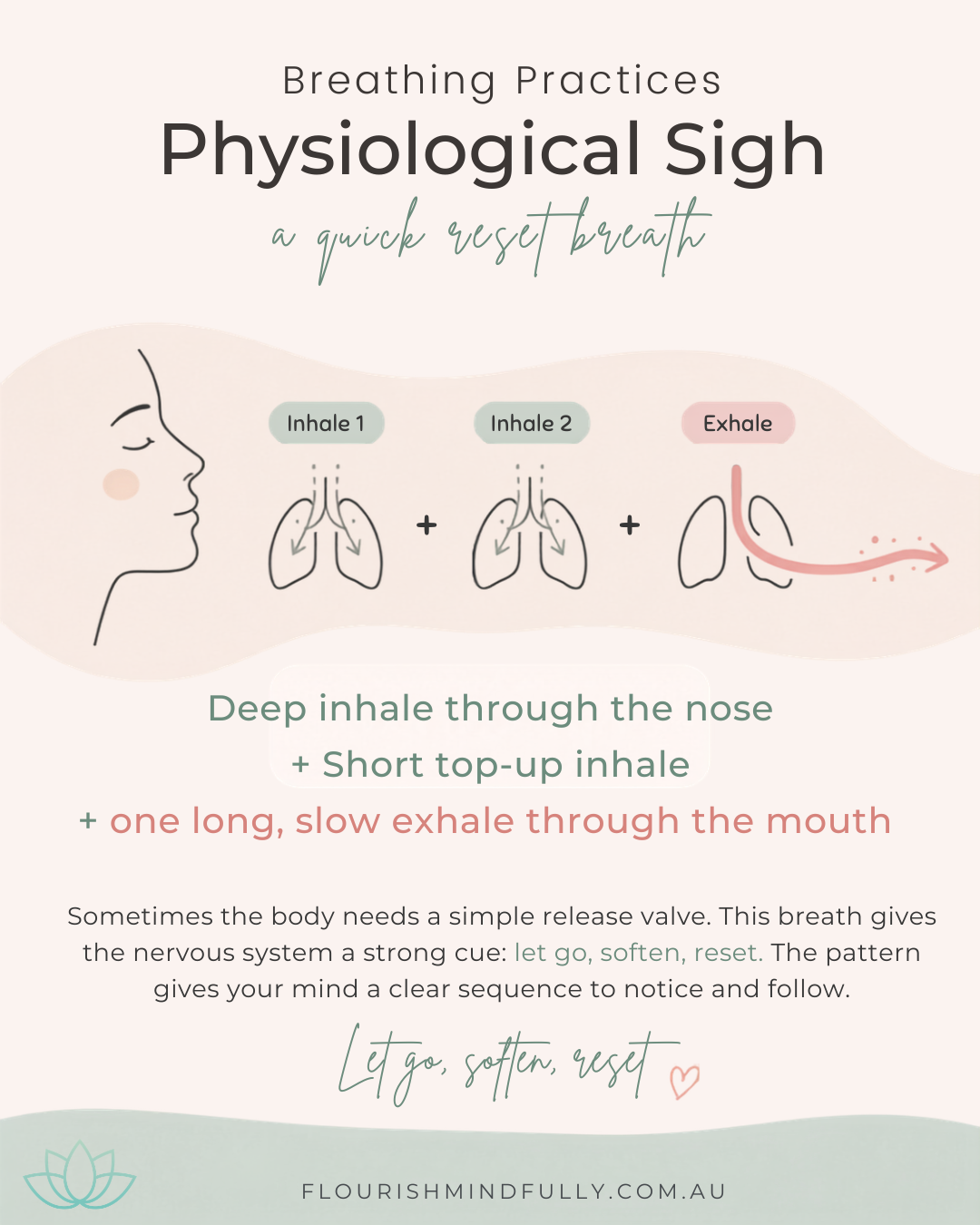
Take one deep inhale through your nose.
Then add a second, shorter inhale through your nose, straight after, without exhaling.
Then release with a long, slow exhale through your mouth.
Not a quick breath out.
A long, soft, slow exhale.
The second inhale helps “top up” the lungs before the long exhale, which is part of why this practice can feel so regulating. This breath has been popularised in recent years by Andrew Huberman, though sighing itself is a natural physiological reset many of us do instinctively.
Why It Works so well
Reinflates air sacs: The double inhale opens up tiny collapsed air sacs in the lungs, that may have been compromised when you haven’t been breathing into your whole lung capacity.
Releases carbon dioxide: It helps your body get rid of excess carbon dioxide quickly.
Slows heart rate: The long exhale activates the parasympathetic nervous system to signal to your body, and mind, that it can relax.
Try it: when you notice tension in your jaw, shoulders, chest or belly; or when you’re been activated by something happening around you.
One fuller than usual inhale (through the nose).
One top-up inhale through the nose (straight after the full inhale).
One long sigh breath out (through the mouth).
Repeat 3 times.
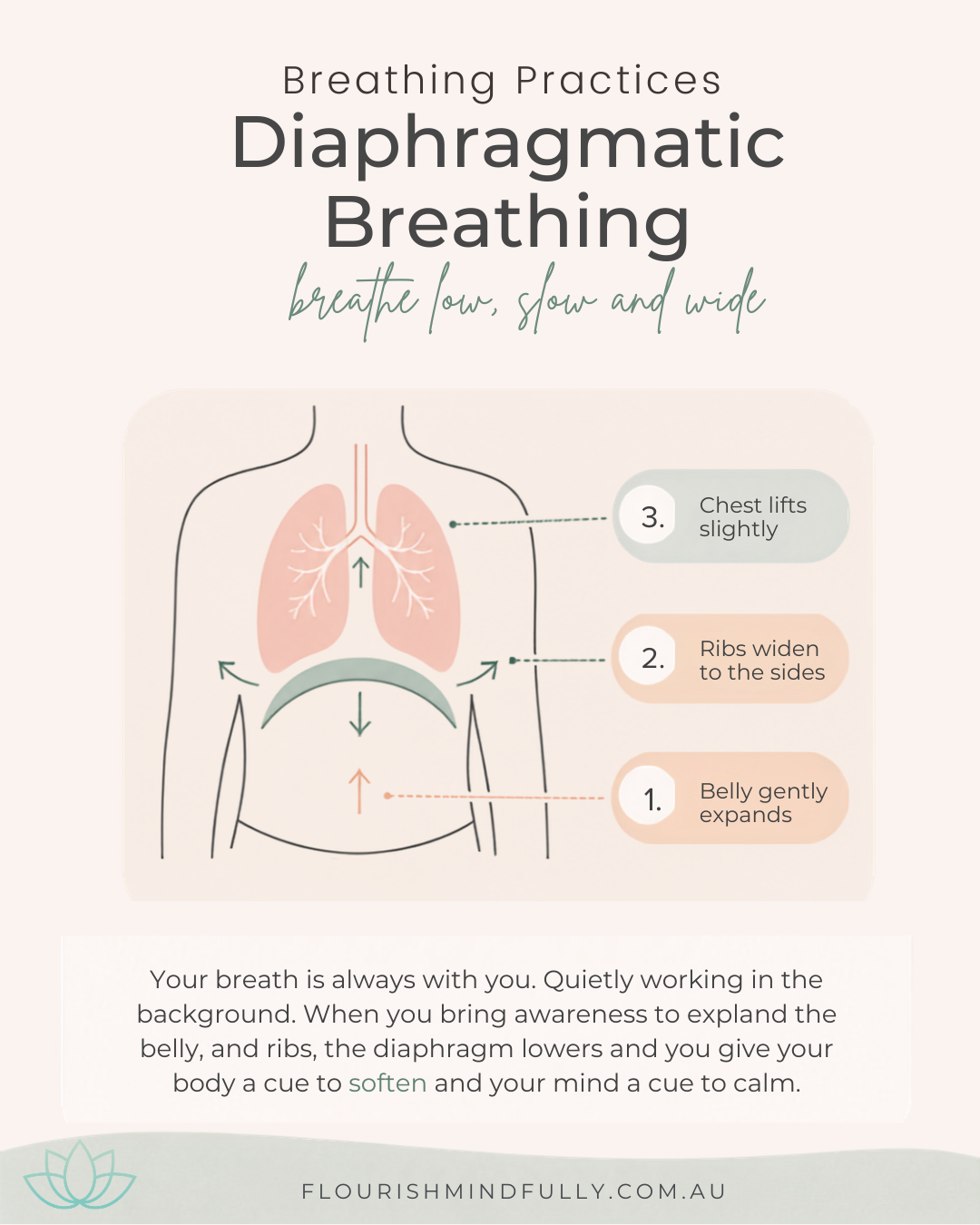
Diaphragmatic breathing is also called belly breathing, abdominal breathing, deep breathing, or in yoga, part of a full yogic breath.
Rather than breathing only high in the chest, this practice invites the breath to move more fully through the body.
The belly gently expands.
The ribs widen to the sides.
The chest may lift slightly.
The diaphragm moves with the breath.
The intercostal muscles between the ribs get to participate, facilitating expansion of the ribs.
As a yoga and meditation teacher, I love this breath practice because it reminds us that breathing is not just air moving in and out.
It is movement.
It is awareness.
It is rhythm.
It is in relationship with the body.
This practice can be especially useful when the breath feels shallow, held, braced or caught high in the chest. This breath allows the full capacity of the lungs to be utilised, and so more oxygen being exchanged in the body.
Try this: place one hand on your belly and the back of the other hand at the side ribs. Notice where the breath is already moving. Then gently invite a little more space.
Can the belly soften a little?
Can the ribs widen slightly?
Can the chest stay easy, lifting slightly at the end of the inhalation?
Can I let my body receive the in breath, and gently release the out-breath?
Let your breath become spacious again.
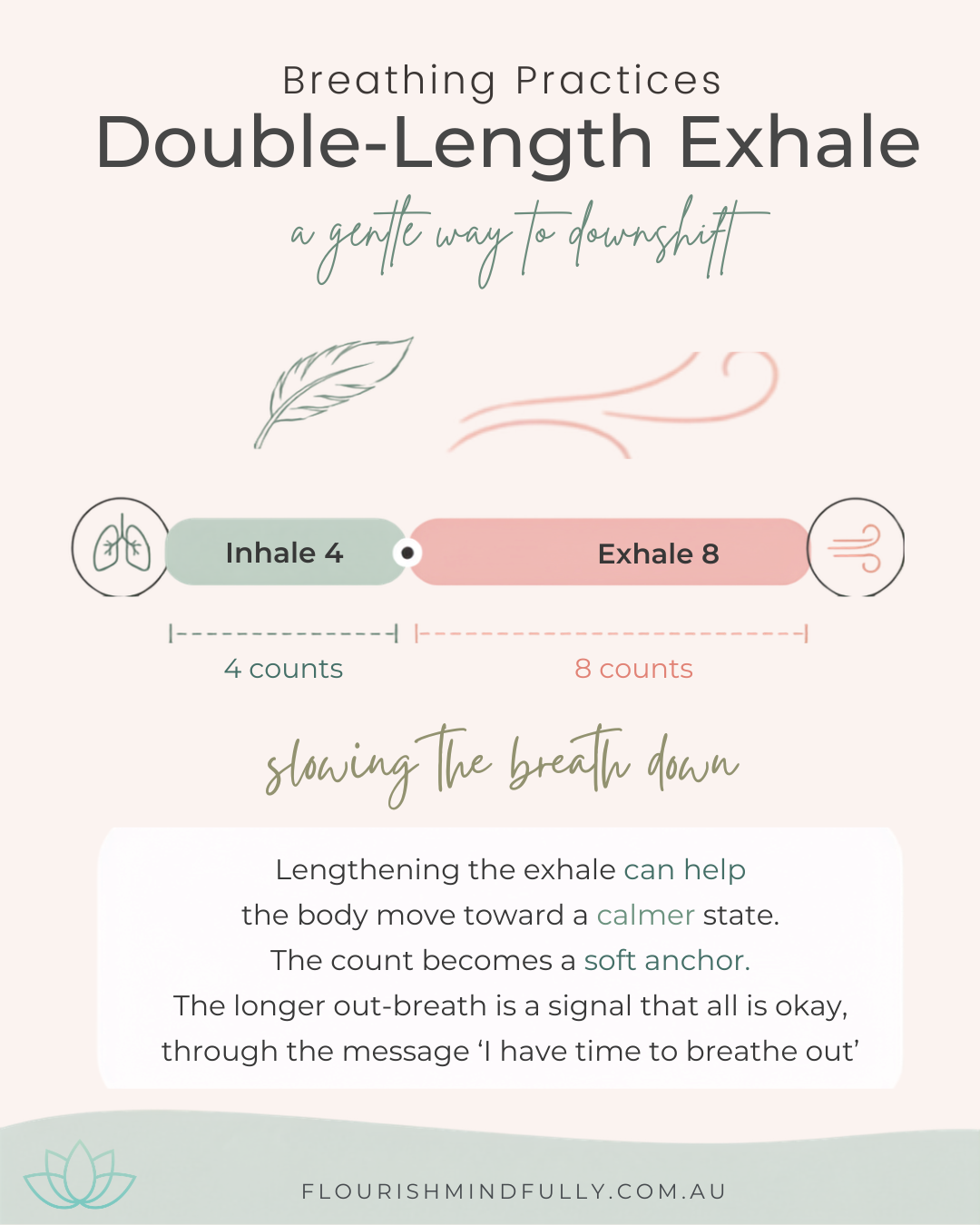
6. Double-Length Exhale
The breath happens on its own - and yet we can gently shift its pattern.
This is one of the simplest breath practices I learned through yoga, long before becoming a therapist.
The inhale is more connected with activation (the Sympathetic Nervous System):
Energy.
Alertness.
Getting up and going.
The exhale is more connected with settling (the Parasympathetic Nervous System):
Rest.
Digestion.
Softening.
Release.
Many of us, especially busy, capable, high-achieving humans, spend so much time in “go mode” that the breath can become short, shallow or inhale-dominant.
So this practice gently preferences the outbreath, to turn this around.
I invite you to build up slowly:
Inhale for 2, exhale for 4.
Then, when you’re comfortable, inhale for 3, exhale for 6.
Then, when you are comfortable, inhale for 4, exhale for 8.
No forcing.
No perfect breath.
No need to get it right.
Just a little more time spent letting go, with each exhalation.
Try this: between work tasks, after school drop-off, before seeing a client, or at the end of a full day.
The exhale is an invitation to:
Soften.
Release.
Return to the present moment.
A gentle note about breath practices
Breath practices aren’t suitable to everyone. If you have any trauma around the breath, it may not be the place to start. There are other grounding practices you can utilise to support you regulating your nervous system.
Breath practices are not about forcing your nervous system to settle before it is ready. They are invitations.
Sometimes the breath helps quickly. Sometimes it does not. Sometimes you may need movement, connection, rest, food, water, boundaries, support or a good cry before the breath feels accessible.
If focusing on the breath makes you feel more anxious, you can keep your eyes open, orient to the room, feel your feet on the floor, or use an external anchor such as sound, touch, colour or movement.
You can also make the practice shorter.
One breath counts.
One pause counts.
One small moment of noticing counts.
The breath is not another thing to get right.
It is a place you can come come home to, time and time again.
A simple way to choose a practice
If you are not sure where to begin, you might try:
For grounding: Phone breathing.
For structure and focus: Box breathing.
For bedtime or night waking: 4-7-8 breathing.
For quick release: Psychological sigh.
For body awareness: Diaphragmatic breathing.
For downshifting: Double-length exhale.
You do not need to practise all of them.
Choose one that feels accessible. Practise it when you are only mildly stressed, so it becomes more familiar before you need it in a more challenging moment.
Support with anxiety, stress and nervous system regulation
If anxiety, stress, overwhelm or burnout are making it difficult to feel settled in your body, counselling or coaching can help you understand what is happening and build tools that feel supportive for you.
As a counsellor and yoga teacher, I often support clients to work with both the mind and the body, making sense of patterns, building emotional awareness, and developing practical strategies for steadiness, self-trust and nervous system regulation.
If you would like support with anxiety, stress, burnout or feeling more grounded in daily life, please feel free to get in touch.