
Nonviolent Communication: Say What You Mean Without Losing Connection
Have you ever tried to explain how you feel, only for the conversation to quickly turn into misunderstanding, defensiveness or conflict?
It starts with something that matters to you.
Maybe you feel overwhelmed by another last-minute change.
Maybe you are tired of carrying the mental load.
Maybe you feel hurt that someone did not check in.
Maybe you are frustrated because you feel like you are always the one accommodating others needs.
The words come out:
“You never listen.”
“You always leave everything to me.”
“You clearly don’t care.”
“I’m so over this.”
And before you know it you’re in a conflict loop, of defensiveness and frustration. Rather than resolving the issue, it may feel worse. And lead you to avoid communicating, until you react from emotion again, and the cycle continues.
There is another approach; a way of communicating that offers more clarity, connection and respect.
Marshall Rosenberg’s Nonviolent Communication (NVC) Model helps move our responses from blaming to understanding, from criticism to connection, and from automatic reaction to a more grounded expression of what is really happening for us, inside.
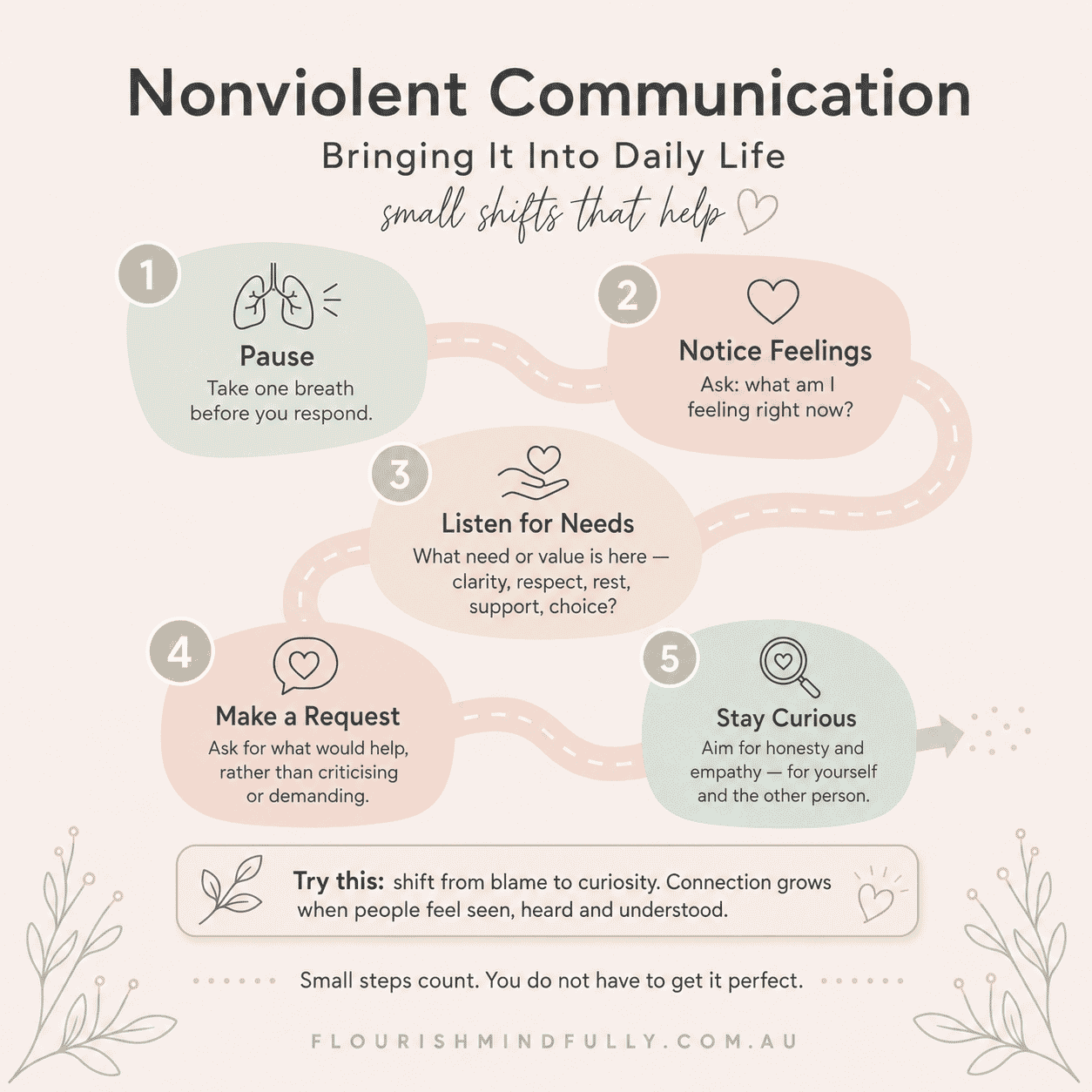
Rosenberg’s model relies on our ability to pause long enough to notice:
What actually happened?
What meaning did I make from it?
What am I feeling?
What am I needing?
What would help now?
This is often new territory. You may not have been taught to name your emotions, let alone in detail, nor to safely express your needs without feeling ashamed of having them.
You may have learned to push through, to keep the peace, to over-explain, to shut down, or to people-please. You say nothing, until emotion, or resentment, builds to a level that results in you being unable to stop the words from come out, unfiltered, unrefined, and not resulting in your needs being met.
NVC provides a structure for a more effective way of communicating.
While NVC is a simple concept, it is a completely new way of communicating for many of us, and so takes some effort to practice and apply.
It assumes there is an interest in understanding yourself – what you are actually feeling, with specificity, and what you are needing from the other person.
And many of us didn’t grow up with this granularity of emotion language, let alone its articulation being modelled for us.
Your emotion vocabulary may be limited to “happy”, “sad”, “scared”, “angry”. Developing your emotion vocabulary is a first step. I like Tom Drummond’s list of Emotions/Feelings for this.
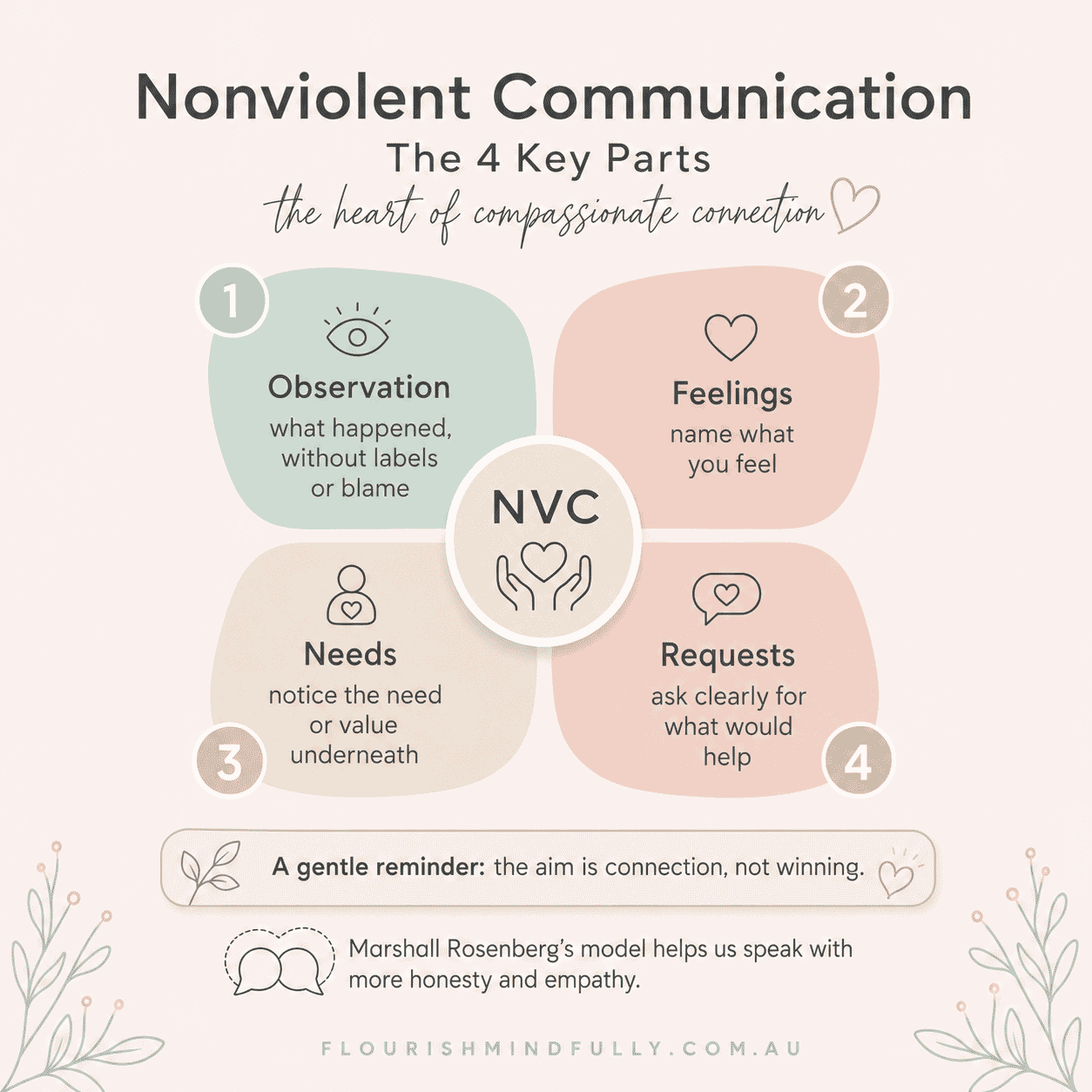
The four parts of Nonviolent Communication
NVC has four elements:
Observation
Feelings
Needs
Requests
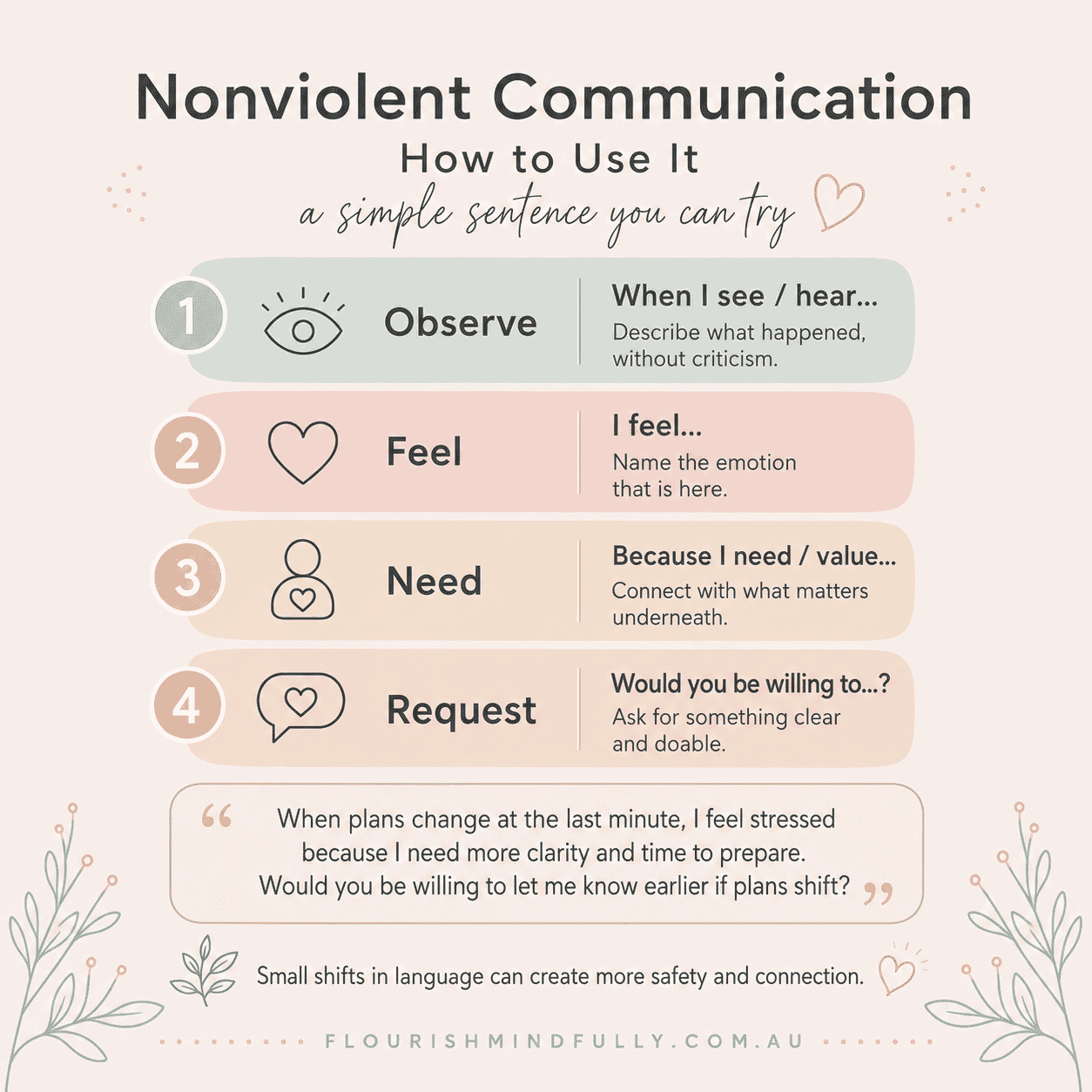
In a conversation, this process sounds like:
When I see or hear…
I feel…
because I need or value…
Would you be willing to…?
For example:
“When plans change at the last minute, I feel stressed because I need clarity and time to prepare/adjust. Would you be willing to let me know earlier if plans shift?”
This can sound structured at first. In real life, you will adapt the wording so it sounds authentic to you.
A key value of the model is that it slows the process down.
Instead of moving straight to blame, defence, shutdown or resentment, this model supports you to begin to separate:
What happened.
What you felt.
What mattered.
What might help.
This separation can change the tone of your conversation.
Start by practising NVC with yourself
Before using NVC in a conversations with someone, it can be helpful to practise with yourself first.
After an interaction with someone, reflect with yourself:
What did I observe?
What did I automatically make it mean?
What am I feeling?
What am I needing?
What request might support me or the relationship?
This is helpful to practice, because when you are activated, you may confuse observation with interpretation.
For example:
Observation:
“They didn’t reply to my message today.”
Automatic meaning, or interpretation:
“They don’t care.”
“I’m not important.”
“I’ve done something wrong.”
“They are pulling away.”
These meanings can feel very real, especially if you have a history of being dismissed, criticised, abandoned, or left to manage things alone.
But they are different to “observation” which is factual.
Practising NVC with yourself in this way helps you create a little more space between what happened and the story your nervous system immediately attaches to it.
It also offers you a training ground, from which to learn the language, and identify and articulate the feelings and needs that are activated in you; so when you begin using it in conversations, you have more familiarity with what is going on for you (in your inner world and nervous system).
1. Observation: What actually happened?
The first step is to describe what happened without judgement, interpretation or blame.
Most of us do not naturally speak in observations. We speak in meaning.
For example (meaning):
“You ignored me.”
“You were rude.”
“You don’t respect my time.”
“You’re being selfish.”
“You don’t care about me.”
They are interpretations.
An observation is more specific, factual, and not emotionally charged.
For example:
“When I sent the message and didn’t hear back today…”
“When the meeting started 20 minutes late…”
“When I came home and the dishes were still on the bench…”
“When I was speaking and you looked at your phone…”
“When I said I was unavailable and was asked again…”
This does not mean your interpretation is wrong or irrelevant, it’s just not the most helpful place to begin the conversation.
Starting with a clear observation gives the other person a better chance of hearing you.
Observation asks:
What did I actually see or hear?
What happened, without adding the story yet?
What am I reacting to, and what meaning have I made from it?
This skill of identifying and articulating the observation is helpful if you tend to move quickly into self-blame, anxiety, anger, withdrawal or people-pleasing.
2. Feelings: What emotion is here?
The second step is to name what you feel.
This is where many people get stuck.
Not because they lack emotional intelligence, but because emotional language is a skill. If you were not encouraged to name your emotions, experience them safely, or express them without judgement or shame, it makes sense that this can feel difficult.
Many high-functioning, capable, responsible people are used to saying:
“I’m fine.”
“I’m stressed.”
“I’m overwhelmed.”
“I’m annoyed.”
“I don’t know.”
“I just feel off.”
These are valid starting points, but they are often broad categories rather than specific emotions.
This is where emotional granularity can help.
Emotion granularity means being able to recognise and describe emotions with more specificity. Instead of saying “I feel bad” or “I feel stressed”, you begin to notice a more precise emotional experience.
For example:
“I feel stressed” might become:
“I feel pressured.”
“I feel stretched.”
“I feel anxious.”
“I feel underprepared.”
“I feel trapped.”
“I feel responsible for too much.”
“I feel scared of disappointing someone.”
“I feel angry” might become:
“I feel dismissed.”
“I feel disrespected.”
“I feel protective.”
“I feel powerless.”
“I feel resentful.”
“I feel hurt.”
“I feel unfairly treated.”
“I feel sad” might become:
“I feel lonely.”
“I feel disappointed.”
“I feel excluded.”
“I feel unimportant.”
“I feel grief.”
“I feel tender.”
“I feel disconnected.”
The more specific you can be, the more useful the information becomes.
If you notice that “resentful” keeps showing up, there may be a repeated unmet need around fairness, support, appreciation or rest. Oftentimes I find clients denying any understandable resentment, so watch for this too. The shame about feeling what your feeling can add another layer.
If “anxious” keeps showing up, there may be a repeated need for clarity, reassurance, preparation or predictability.
If “hurt” keeps showing up, there may be a need for care, respect or being understood.
You might also try noticing how emotion shows up in your body, as clues for the words.
A tight chest.
A clenched jaw.
A heavy feeling.
A lump in the throat.
A sudden urge to cry.
A need to withdraw.
A sharp tone that arrives before you expected it.
Use this, your body’s information, to map the emotion that it relates to, for you.
You can explore building emotion granularity by asking yourself:
Is this more like anger, sadness, fear, shame, hurt, disappointment or overwhelm?
What flavour of that emotion is it?
Is this familiar?
When does this emotion tend to show up?
What does this emotion usually need from me?
You can also use a feelings list, journal after difficult moments, or work with a counsellor or coach to identify your recurring emotional themes.
The aim is not to analyse yourself perfectly, rather begin to understand yourself more clearly.
3. Needs: What matters underneath?
This is the next layer, or emotional attunement, in NVC.
Under your feelings are needs.
Needs are not demands. They are not “I need you to do exactly what I want.” They are your human values, longings and the conditions that support your wellbeing, safety, connection and dignity.
Common needs include:
Clarity
Respect
Rest
Support
Choice
Understanding
Care
Connection
Autonomy
Reliability
Appreciation
Space
Safety
Honesty
Ease
Belonging
Contribution
Consideration
Reassurance
Consistency
Time to prepare
Repair
Fairness
Kindness
Emotional presence
This element of the model can be challenging, and even confronting, because many of us are not used to asking:
What do I need?
You may be more comfortable asking:
What does everyone else need from me?
What should I do?
How do I keep the peace?
How do I not disappoint anyone?
How do I get through this?
How do I stay low-maintenance?
If you have low self-esteem, insecure attachment patterns, or a long history of being the capable one, having needs can bring feelings of shame.
You may have learned, directly or indirectly:
I should be able to look after myself.
I should not bother people with my problems.
My needs are too much.
If I need reassurance, I am needy.
If I ask for care, I am weak.
If I need support, I am inadequate.
If someone cannot meet my need, it means I am unlovable.
These beliefs can run deep.
And they can make it hard to recognise your needs without judging yourself for having them.
But having needs does not make you needy.
Having needs does not make you inadequate.
It does not make you unworthy.
It does not make you broken.
It does not make you unlovable.
Having needs makes you human.
A need is information about what matters to you and what supports your wellbeing.
You may still need to choose how, when and with whom you express a need. Not every person will be able, or willing to meet it. But the need itself is not wrong.
A useful self-practice is to ask:
What is this feeling pointing to?
What matters here?
What value feels unmet?
What would help me feel more steady, respected or supported?
Is this a need for care, clarity, connection, space, rest, reassurance, honesty or healing?
For example:
If I feel resentful, I may need fairness, support, appreciation or shared responsibility.
If I feel anxious, I may need clarity, reassurance, stability, preparation or safety.
If I feel hurt, I may need care, time to recover, understanding or consideration.
If I feel overwhelmed, I may need rest, space, clarity, help or fewer demands.
If I feel angry, I may need respect, boundaries, honesty or choice.
If I feel lonely, I may need connection, inclusion or emotional presence.
If I feel shut down, I may need time, safety, less pressure or a slower conversation.
Learning to identify your needs is a practice.
Sometimes the need underneath only becomes clear later. Sometimes it becomes clear in conversation. Sometimes it becomes clear after writing it down. Sometimes support helps you hear yourself more accurately.
This is often where counselling or coaching can be useful, especially if you are used to minimising your needs, judging yourself for having them, or only noticing them once resentment has built.
4. Requests: What clear, doable thing would help?
The final step in NVC is to make a request.
A request is different from a demand.
A demand says:
“You must do this, or else.”
A request says:
“This would help. Is this something we can talk about?”
Requests are most useful when they are clear, specific and doable.
“Can you be more supportive?” is understandable, but it may be too broad.
More specific requests might sound like:
“Can you sit with me for ten minutes while I talk this through?”
“Can we look at the calendar together before saying yes to anything else this weekend?”
“Could you let me finish speaking before responding?”
“Can you tell me when you are unavailable rather than leaving the message unanswered?”
“Could we agree who is responsible for which tasks this week?”
“Can you acknowledge the work I did today? I think I need to feel seen.”
“Would you be willing to…” is common in NVC because it leaves room for choice. But it is not the only option.
If that phrase feels unnatural, you might try:
“Would you be open to…?”
“Could we try…?”
“Can I ask for…?”
“What I’d really appreciate is…”
“What would help me is…”
“Would it work for you to…?”
“Can we make a plan for…?”
“Could you let me know…?”
“Would now be a good time to talk about…?”
“I’m wondering if we could…”
“I’d like to ask for…”
For some people, “Would you be willing to…” can feel too formal or therapeutic. The aim is not to perform NVC perfectly. The aim is to make a clear, respectful request that gives the other person something concrete to respond to.
It can also help to name the vulnerability:
“This feels a bit awkward to ask, but I’m practising being clearer.”
“I’m not trying to blame you. I’m trying to explain what would help.”
“I’m still working out the words, but I think I need more clarity here.”
“I feel nervous asking this, but I’d like to try.”
This matters because making requests can feel exposing.
Especially if you fear rejection, dismissal, conflict, or being seen as too much.
A request also means the other person can say no. That can be hard. But a no does not mean your need is wrong. It means this person may not be able or willing to meet it in that way, at that time.
From there, you can ask:
Is there another way this need could be met?
Is this a relationship where my needs can be considered?
Do I need support, a boundary, a different conversation, or a different source of care?
A request gives your need a voice, and a pathway forward.
It does not guarantee the outcome, but it makes understanding more possible.
Using NVC with yourself first
NVC is not only for conversations with other people.
It can also be a powerful self-awareness and self-compassion practice.
Many of us speak to ourselves in harsh, critical ways:
“I’m hopeless.”
“I should be over this.”
“I’m too sensitive.”
“I can’t cope.”
“I’ve failed again.”
“I’m too needy.”
“I shouldn’t need this much reassurance.”
NVC invites a different kind of inner conversation.
Instead of immediately judging yourself, you can ask:
What happened?
What did I make it mean?
What am I feeling?
What am I needing?
What would support me now?
For example:
Instead of:
“I’m so unproductive.”
Try:
“When I notice I’m struggling to begin, I feel flat and overwhelmed because I need rest, structure and a manageable starting point. What is one small next step?”
Instead of:
“I shouldn’t be upset.”
Try:
“When I notice I’m upset, I feel vulnerable because I need understanding and care. Can I give myself a moment before I respond?”
Instead of:
“I always mess things up.”
Try:
“When something doesn’t go the way I hoped, I feel disappointed because I value doing things well. What support am I needing now?”
Instead of:
“I’m too needy.”
Try:
“When I notice I want reassurance, I feel embarrassed and anxious because I need connection and steadiness. Can I offer myself some reassurance first, and then decide whether I want to ask someone else for additional support?”
The request of yourself could be in the format:
“Can I…”
“Am I able to…”
“What would support me now?”
“What is one next step?”
“What can I offer myself first?”
“What boundary would help?”
“What do I need to ask for?”
“What is within my control here?”
“Can I give myself five minutes before responding?”
“Can I write this down before I send the message?”
For self-practice, “Would I be willing to…” (the typical NVC language) is sufficient if it helps you pause and choose. But it is not the only wording. What matters is that the request is kind, clear and actionable.
Everyday examples of Nonviolent Communication
When plans change at the last minute
Reactive version:
“You always do this. You don’t respect my time.”
NVC version:
“When plans change at the last minute, I feel stressed because I need clarity and time to prepare. Could you let me know earlier if plans might shift?”
Possible needs underneath:
Clarity | Consideration | Reliability | Time to prepare | Respect for your energy
When you are carrying the mental load
Reactive version:
“I have to do everything around here.”
NVC version:
“When I’m the one keeping track of appointments, meals, washing and family tasks, I feel overwhelmed and resentful because I need more shared responsibility. Can we sit down and divide the weekly tasks more clearly?”
Possible needs underneath:
Support | Fairness | Shared responsibility | Rest | Recognition
When someone interrupts you
Reactive version:
“You never listen to me.”
NVC version:
“When I’m speaking and I’m interrupted, I feel hurt and frustrated because I need to feel heard. Could you let me finish before responding?”
Possible needs underneath:
Respect | Being heard | Consideration | Presence | Understanding
When a friend does not check in
Reactive version:
“You clearly don’t care about me.”
NVC version:
“When I didn’t hear from you after I shared that I was having a hard week, I felt sad and alone because I need care and connection. What would help me is a check-in when I tell you I’m struggling. Is that something you could do?”
Possible needs underneath:
Care | Connection | Emotional presence | Reassurance | Belonging
When work requests keep piling up
Reactive version:
“Everyone just keeps dumping things on me.”
NVC version:
“When more tasks are added without checking my capacity, I feel pressured and anxious because I need clarity and realistic expectations. Could you help me prioritise what needs to be done first?”
Possible needs underneath:
Clarity | Capacity | Support | Realistic expectations | Choice
When you need rest but feel guilty
Reactive version:
“I’m just useless. I should be able to cope.”
NVC version to self:
“When I notice I’m exhausted and still pushing myself, I feel depleted because I need rest and care. Can I pause and do one thing that supports my body today?”
Possible needs underneath:
Rest | Self-compassion | Recovery | Permission | Care
When someone gives advice too quickly
Reactive version:
“You’re not listening. You’re just trying to fix me.”
NVC version:
“When I share something vulnerable and receive advice straight away, I feel unseen because I need empathy before solutions. Could you listen first and ask if I want advice?”
Possible needs underneath:
Empathy | Understanding | Emotional safety | Choice | Being witnessed
When your boundary is not respected
Reactive version:
“I already told you no. Why do you keep asking?”
NVC version:
“When I say I’m not available and I’m asked again, I feel pressured because I need my no to be respected. I’d like you to be okay with my answer the first time.”
Possible needs underneath:
Respect | Autonomy | Choice | Space | Trust
When you feel criticised
Reactive version:
“You’re always judging me.”
NVC version:
“When I hear feedback in a sharp tone, I feel defensive and hurt because I need respect and kindness while we talk about difficult things. Could we slow this conversation down?”
Possible needs underneath:
Respect | Kindness | Emotional safety | Fairness | Openness
When you are waiting for a reply
Reactive version:
“You never reply. I’m obviously not important.”
NVC version:
“When I don’t hear back for a few days, I feel anxious and uncertain because I need reassurance and clarity. Could you let me know when you’re unavailable rather than leaving it open-ended?”
Possible needs underneath:
Reassurance | Clarity | Connection | Reliability | Security
A simple practice to try
The next time you feel activated, write down these five lines:
1. What happened?
“When…”
2. What meaning did I make from it?
“The story my mind told me was…”
3. What am I feeling?
“I feel…”
4. What am I needing or valuing?
“Because I need/value…”
5. What would help?
“Could I…?”
“Could we…?”
“Would you be open to…?”
“What I’d appreciate is…”
For example:
“When I see emails coming in after hours, the story my mind tells me is that I have to respond immediately. I feel tense and pressured because I need rest and separation from work. Can I leave these until tomorrow morning?”
Or:
“When I notice I keep saying yes when I’m already tired, the story my mind tells me is that I’ll disappoint people if I say no. I feel resentful because I need choice and space. Can I pause before answering?”
Or:
“When I don’t know what someone expects from me, the story my mind tells me is that I’ll get it wrong. I feel anxious because I need clarity. Could I ask for more information?”
Taking time to reflect and write this down for yourself can help you understand your experience and what is happening for you.
NVC is more than a conversation tool. It is also a way of noticing your inner world with more nuance and compassion.
A reminder
The aim of Nonviolent Communication is not to become perfectly articulate or perfectly compassionate.
The aim is to create more space between what happens and how you respond.
It helps you ask:
What is really happening here?
What story am I making from this?
What am I feeling?
Can I name this feeling more specifically?
What am I needing?
Can I validate the need without judging myself for having it?
What request could support connection, clarity or care?
Sometimes the conversation will go well. Sometimes it will still be messy. Sometimes you may only realise what you felt or needed hours later.
That is still useful information you can build on, in understanding your feelings and needs.
Awareness is a practice.
Emotion language is a practice.
Clear communication is a practice.
Self-compassion is a practice.
Small shifts count.
Further resources for practising Nonviolent Communication
Nonviolent Communication can be simple to understand, but harder to put into practice, especially if naming feelings, identifying needs, or making clear requests feels new or vulnerable.
The resources below can support you to practise.
1. Naming feelings more clearly
CNVC Feelings and Needs Inventory
The Center for Nonviolent Communication’s list can support you to move from general words like “bad”, “fine” or “upset” into more specific emotional language.
View the CNVC Feelings and Needs Inventory
2. Identifying what you need
NVC Academy Feelings and Needs PDF
This practical feelings and needs resource can help you notice what may be sitting underneath frustration, anxiety, resentment, sadness or shutdown.
Download the NVC Academy Feelings and Needs PDF
CNVC — Learning Nonviolent Communication
A useful place to explore the foundations of NVC and better understand the role of feelings, needs, empathy and requests.
Explore CNVC learning resources
3. Making clear requests
4-Part Nonviolent Communication Process
This one-page poster explains the four-part structure of NVC: observation, feelings, needs and requests. You can use this to support you in turning a complaint or criticism into something clearer and more constructive.
Learn the 4-Part NVC Process
4. Training and deeper practice
NVC Academy
Offers free and paid courses, self-paced learning and training resources for people wanting to deepen their understanding of NVC.
Visit NVC Academy
NVC Australia
For Australian-based trainers, practice groups and training opportunities.
Find NVC Australia trainings
Support with applying this in your own life
Sometimes it is easier to understand the model than to apply it in the moments that matter most.
If you find it hard to know what you are feeling, what you need, or how to express yourself without blame or fear, counselling or coaching can help you slow things down and find language that feels authentic to you.
Support can help you practise new ways of relating — with yourself and with the people who matter to you.
If you would like support with communication, boundaries, self-awareness or relationship patterns, you are welcome to get in touch with me, Nicky.